Basement finishing in Northern Virginia
The 2025 Cost vs. Value report put a basement remodel at $52,7571 in its Washington, DC market, which covers Northern Virginia, a little above the $52,0122 national figure. In Fairfax County the age of the house and the rooms you add set the rules: a basement in a house built after October 2003 needs an emergency escape opening, any basement bedroom needs one regardless, and a kitchen, wet bar or bedroom means sending plans to the county.
Calls are recorded. One independent company that handles basement finishing in the Northern Virginia area answers.
Updated October 11, 2026
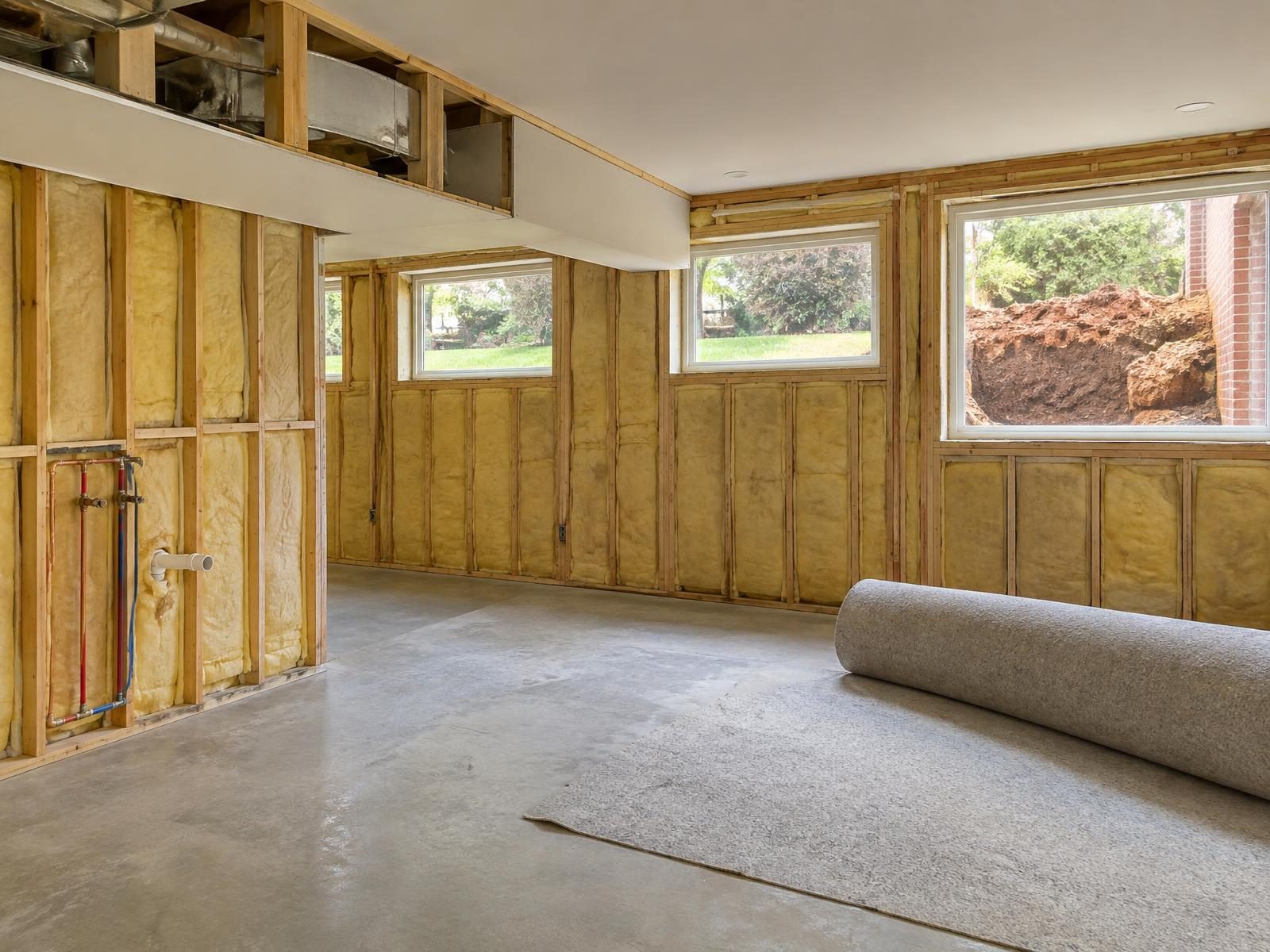
What a finished basement costs in the Washington market
The Washington, DC market is the closest Cost vs. Value comes to Northern Virginia. Its 2025 basement job, a family room with a wet bar and a full bath, is shown here with what agents expect it to return at sale.
| Measure | Washington, DC market | U.S. average |
|---|---|---|
| Basement remodel, job cost | $52,7571 | $52,0122 |
| Basement remodel, resale value | $39,9541 | $36,9052 |
| Basement remodel, cost recouped at resale | 76%1 | 71%2 |
Here the job gets back a larger share of its price at sale than it does nationally. That figure assumes a dry lower level with enough headroom; a new escape window, waterproofing or a radon system comes on top of it.
Basements older than the escape-window rule
Fairfax County's Census counts stand in for Northern Virginia. The county ties its basement escape-opening rule to houses built after October 2003, and most homes in the county are older than that.
| Measure | Fairfax County | Washington metro |
|---|---|---|
| Homes built before 2000 | 80%3 | – |
| Homes built 1960–1989 | 55%3 | 39%3 |
| Homes built before 1980 | 44%3 | 45%3 |
An older Fairfax basement can be finished without an escape opening unless it gains a bedroom, though the county strongly recommends one. Cutting it in while the walls are bare is far simpler than coming back for it once the room is done.
Pay for the basement trades
BLS medians for the Washington metro, which covers Northern Virginia, for the trades that frame a lower level, hang its drywall and run its power and drains.
| Measure | Washington metro | United States |
|---|---|---|
| Carpenters, median hourly wage | $29.23/hr4 | $29.12/hr4 |
| Drywall and ceiling tile installers, median hourly wage | $28.40/hr4 | $28.33/hr4 |
| Electricians, median hourly wage | $36.50/hr4 | $30.38/hr4 |
| Plumbers, median hourly wage | $34.55/hr4 | $30.67/hr4 |
Framing and drywall, which make up much of a basement job, are paid close to the national median here. A bathroom or wet bar brings in the plumber and more circuits, and those are the trades whose local pay runs well above it.
Summer air below grade
NOAA records at Northern Virginia's two big airports show muggy July afternoons. When that warm, damp air meets a foundation wall or slab cooled by the ground, condensation follows.
| Measure | Dulles Airport | Reagan National |
|---|---|---|
| July afternoon relative humidity | 54%5 | 53%5 |
The EPA warns that carpet on a basement slab can stay damp from water or vapor coming up through the concrete, or from room moisture condensing on a slab that is colder than the air, and either can lead to mold.6 In a Fairfax lower level, plan for a dehumidifier with a drain line and a floor that can take some damp without harm.
Space added under a valuable house
Census medians put the typical owner-occupied Fairfax County house well above the Washington metro figure, so a new rec room or guest suite is being added to a costly house, not a starter home.
Permits
These are Fairfax County's rules; Arlington, Loudoun, Prince William, Alexandria and Falls Church each run their own permit office. In Fairfax, finishing a basement needs a building permit, and the work has to follow the county's typical basement details or approved plans. A kitchen, wet bar, bedroom or new opening in the foundation wall sends the job to plan review, and waterproofing or foundation repair is permitted work in its own right.
- Fairfax County lists finished basements, creating a bedroom, and installing new window or door openings among the interior alterations that need a permit.8
- Finished basements in Fairfax County must be built to the county's Typical Finished Basement Details, and a copy must be on the job site for the inspector at each required inspection.9
- Fairfax County requires a plan submission and county approval for a finished basement that includes a kitchen, wet bar or bedroom, and for cutting a new opening in an exterior basement wall.9
- In Fairfax County, an emergency escape and rescue opening is required in the basement of a house built after October 1, 2003 and in every basement bedroom whatever the house's age; older basements may be finished without one, though the county strongly recommends it.9
- A new window well in Fairfax County needs a plan submission and at least 9 square feet of floor area with the window open, must drain to the foundation drain or to grade, and needs a permanent ladder or steps if it is deeper than 44 inches.9
- Fairfax County requires a permit for miscellaneous residential work such as areaways, asbestos removal, chimney repairs, foundation repairs, waterproofing and roof repairs.8
- Residential alteration permits are applied for online in the county's PLUS system, and electrical and plumbing permits for the same project are issued after the building permit and linked to it.10
Checked October 11, 2026
Talk to a pro who handles basement finishing in Northern Virginia
Calls are recorded. You'll be connected to one independent company that handles basement finishing in your area. We never call or text you. Privacy Policy ·Do Not Sell or Share My Personal Information
Test for radon before the walls go up
The EPA classifies Fairfax County as Zone 1, its highest radon potential, where average indoor screening levels are predicted to be above 4 picocuries per liter.11 The EPA recommends testing for radon on the lowest lived-in level, so a basement that hasn't been tested should be tested before it is remodeled; fixing a radon problem is usually easier and cheaper before the basement is finished.6
The Virginia Department of Health offers a limited supply of short-term do-it-yourself radon test kits for a $4 shipping fee, while supplies last.12 The EPA's guidance is to fix your home if radon tests at 4 picocuries per liter or higher, and to consider fixing it between 2 and 4.13 If a mitigation fan and pipe turn out to be needed, decide where they run before the ceiling and walls close in.
Split-level lower levels and walkout basements
Many Fairfax County houses from the 1960s and 1970s are split-levels whose lowest floor sits partly above ground, or colonials on sloping lots with a walkout door to the back yard. Those layouts make the escape opening easier: the county accepts a window or door in a walkout wall, where a fully buried basement needs a well dug outside the window.
Fairfax County's basement details set a minimum basement ceiling height of 7 feet above the finished floor, with beams, girders and ducts allowed to project to within 6 feet 4 inches of the floor.9 An older split-level can come up short once a drywall ceiling and new flooring go in, so measure to the lowest duct and beam before planning a bedroom down there.
Fairfax County uses a second kitchen certification during building permit review to document and approve a second kitchen that is not used as an accessory living unit, such as one in a basement entertaining area; the 2026 proposal would write that practice into the zoning ordinance.14 If the plan includes a full kitchen on the lower level, ask the company how the county will review it before cabinets are ordered.
What the county's basement details ask for
Fairfax County's typical basement details call for at least R-13 insulation over the full height and length of the basement wall, with the vapor barrier on the warm side.9 Building America advises keeping fiberglass batts and cellulose out of contact with foundation walls, and not putting polyethylene sheeting, vinyl or foil wallpaper, or epoxy, oil or alkyd paint on the inside of basement walls, because they trap moisture.15 Ask the company how its wall assembly meets the county detail while keeping moisture out of the framing.
Fairfax County's basement details call for hardwired, interconnected smoke alarms with battery backup in the basement and in each basement bedroom, plus a carbon monoxide alarm outside sleeping areas when a bedroom is added to a house with a gas-fired appliance or an attached garage.9 Under Fairfax County's basement details, every receptacle installed in a basement needs ground-fault (GFCI) protection, and each unfinished part of the basement must keep at least one receptacle.9
Fairfax County's basement details require furnaces, water heaters and similar appliances to stay reachable without removing permanent construction, with a clear floor space of 30 by 30 inches on the control side.9 Mark that clear space on the floor plan before the walls are framed, so the furnace closet isn't drawn too tight.
Water before walls
Before turning basement space into living space, the EPA advises checking it for leaks and other signs of moisture and fixing any moisture problem first, because damp basements promote mold and other biological growth.6 Fairfax County requires a permit for miscellaneous residential work such as areaways, asbestos removal, chimney repairs, foundation repairs, waterproofing and roof repairs.8 If the plan includes an interior drain, a sump or exterior waterproofing, it should appear on the permit as well as the quote.
A lower-level suite for a parent
More than one in four adults 65 and older fall each year.16 A bedroom suite on the walkout level of a sloping-lot colonial puts the bedroom, the bath and an outside door on one floor, so the stairs are not the only way in or out.
15%17 of Fairfax County seniors report serious difficulty walking or climbing stairs. If the suite is meant for a parent, ask whether they will manage the basement stairs at all, and plan a level path from the driveway to the walkout door if not. NAHB's Certified Aging-in-Place Specialist (CAPS) credential trains remodelers in home modifications for aging in place.18
What happens when you call
The number on this page connects your recorded call to one independent company that handles basement finishing in the Northern Virginia area. You go over the space, the rooms you want and the price directly with them.
We're paid by that company for the call. You pay us nothing, and we never call or text you. How we make money
After you're connected
Check the company in Virginia's license records before you sign. Virginia's Board for Contractors licenses contracting businesses as Class A, B or C; the class sets the dollar value of jobs a firm may take on, and its classification or specialty sets the type of work it may do.19 Virginia's Department of Professional and Occupational Regulation advises hiring only licensed contractors, and its License Lookup shows a license's status and any past disciplinary actions.20 Check a Virginia license
Ask who will apply for the permits and keep a copy of the county's basement details on site. Owners may get Fairfax County permits in their own name, but the county strongly recommends that a properly licensed contractor pull them as the responsible party.10
Questions people ask
How much does it cost to finish a basement in Northern Virginia?
Cost vs. Value's 2025 basement job, with a wet bar and a full bath, came to $52,7571 in the Washington, DC market and was expected to return $39,9541 at resale. A Fairfax basement that also needs an escape window, waterproofing or radon work will cost more than that.
Does my Fairfax County basement need an egress window?
It depends on when the house was built and which rooms you add. In Fairfax County, an emergency escape and rescue opening is required in the basement of a house built after October 1, 2003 and in every basement bedroom whatever the house's age; older basements may be finished without one, though the county strongly recommends it.9
Do I need plans to finish a basement in Fairfax County?
Sometimes. Finished basements in Fairfax County must be built to the county's Typical Finished Basement Details, and a copy must be on the job site for the inspector at each required inspection.9 Fairfax County requires a plan submission and county approval for a finished basement that includes a kitchen, wet bar or bedroom, and for cutting a new opening in an exterior basement wall.9
Should I test for radon before finishing the basement?
Yes. The EPA classifies Fairfax County as Zone 1, its highest radon potential, where average indoor screening levels are predicted to be above 4 picocuries per liter.11 The Virginia Department of Health offers a limited supply of short-term do-it-yourself radon test kits for a $4 shipping fee, while supplies last.12
Sources
Page updated October 11, 2026. How we source our numbers
- Zonda / Journal of Light Construction, Cost vs. Value 2025, Washington, DC. Released 2025. Washington, DC. Industry source.
- Zonda / Journal of Light Construction, Cost vs. Value 2025, national. Released 2025. United States. Industry source.
- U.S. Census Bureau, American Community Survey 2020–2024 5-year, table B25034. Released January 29, 2026. Fairfax County, VA, Washington-Arlington-Alexandria metro.
- U.S. Bureau of Labor Statistics, Occupational Employment and Wage Statistics, May 2025. Released May 15, 2026. Carpenters, Washington-Arlington-Alexandria metro, Carpenters, United States, Drywall and ceiling tile installers, Washington-Arlington-Alexandria metro, Drywall and ceiling tile installers, United States, Electricians, Washington-Arlington-Alexandria metro, Electricians, United States, Plumbers, Washington-Arlington-Alexandria metro, Plumbers, United States.
- NOAA National Centers for Environmental Information, Comparative Climatic Data, average relative humidity, data through 2023. Released November 2024. Washington Dulles Airport (WBAN 93738).
- U.S. Environmental Protection Agency, Remodeling Your Home and Indoor Air Quality. Released February 17, 2026. View source.
- U.S. Census Bureau, American Community Survey 2020–2024 5-year, table B25077. Released January 29, 2026. Fairfax County, VA, Washington-Arlington-Alexandria metro.
- Fairfax County Land Development Services, Does My Project Require a Permit?. No publication date. View source.
- Fairfax County Land Development Services, Typical Finished Basement Details (based on the 2021 Virginia Residential Code). No publication date. View source.
- Fairfax County Land Development Services, Permit Library: Addition/Alteration (ALTR), Residential. No publication date. View source.
- Fairfax County Health Department, Radon. Released January 16, 2020. View source.
- Virginia Department of Health, Indoor Radon Program. Released December 17, 2025. View source.
- U.S. Environmental Protection Agency, Health Risk of Radon. Released June 24, 2026. View source.
- Fairfax County Department of Planning and Development, Staff Report: Zoning Ordinance Amendment, Accessory Living Units. Released September 29, 2026. View source.
- U.S. Department of Energy, Building America Top Innovations: Basement Insulation Systems. No publication date. View source.
- Centers for Disease Control and Prevention, Facts About Older Adult Falls. Released September 4, 2026. View source.
- U.S. Census Bureau, American Community Survey 2020–2024 5-year, table S1810. Released January 29, 2026. Fairfax County, VA.
- National Association of Home Builders, Certified Aging-in-Place Specialist (CAPS). No publication date. View source. Industry source.
- Virginia Department of Professional and Occupational Regulation, Board for Contractors. No publication date. View source.
- Virginia Department of Professional and Occupational Regulation, DPOR Consumer Guide: Hiring a Contractor. No publication date. View source.