Accessible bathrooms in Montgomery County
A universal-design bathroom cost $41,8321 in the Washington, DC market in the 2025 Cost vs. Value report, a little under the $42,1832 national figure. In Montgomery County the local factor that changes the math is the county's Design for Life property tax credit, which can return part of what you spend on grab bars, a curbless shower or a wider door, as long as the work is permitted and passes the county's inspection.
Calls are recorded. One independent company that handles accessible bathrooms in the Montgomery County area answers.
Updated October 11, 2026
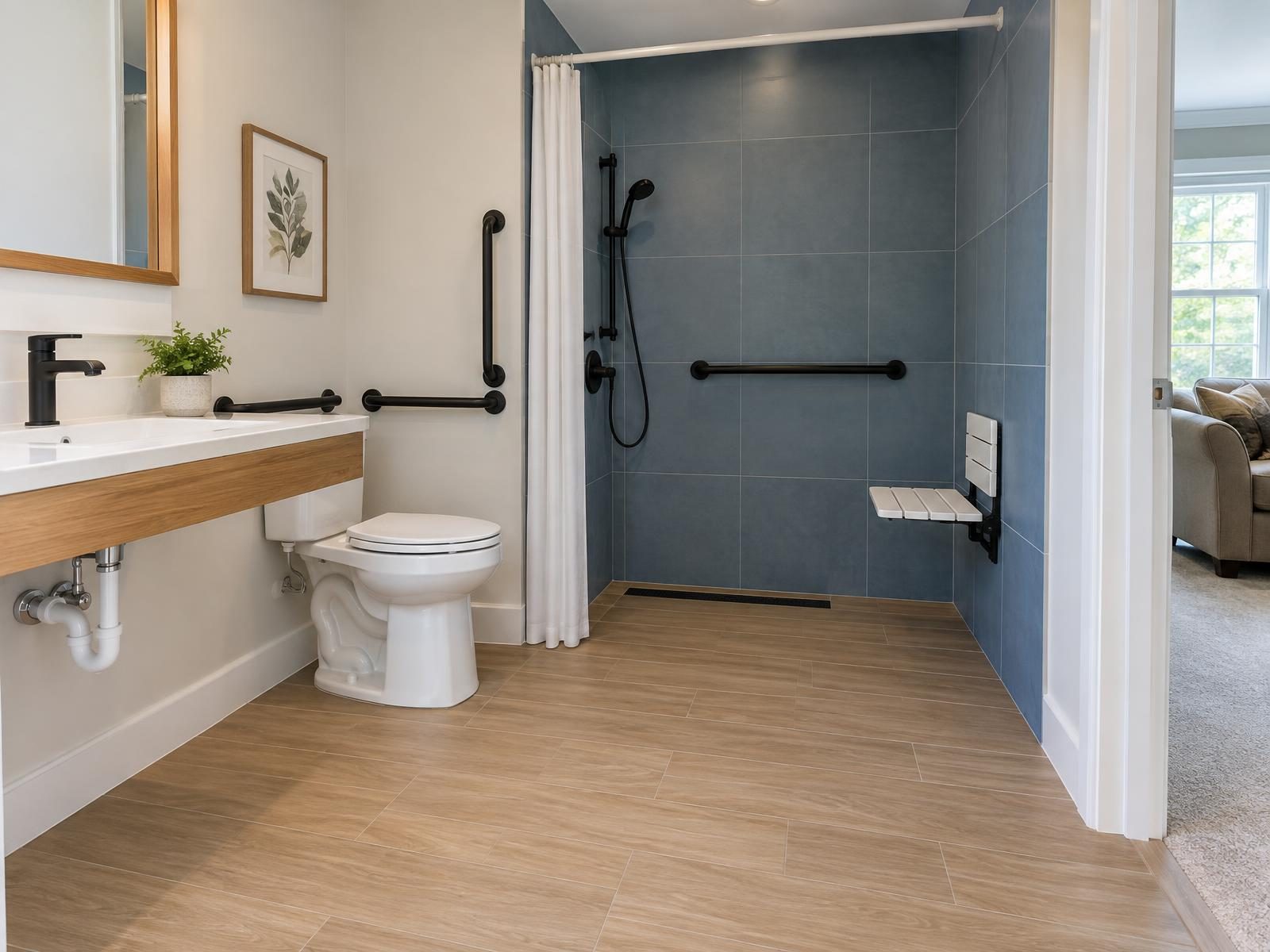
Universal design priced in the Washington market
Cost vs. Value prices a universal-design bath in its Washington, DC market, the closest it comes to Montgomery County, and asks local real estate agents what the room adds when the house sells.
| Measure | Washington, DC market | U.S. average |
|---|---|---|
| Universal-design bathroom remodel, job cost | $41,8321 | $42,1832 |
| Universal-design bathroom remodel, resale value | $25,9921 | $25,8122 |
| Universal-design bathroom remodel, cost recouped at resale | 62%1 | 61%2 |
Agents in this market value the finished room slightly above the national survey. If you intend to stay, the return that matters more is not having to move when stairs or a tub wall become hard to manage.
Older owners in the county
The Census Bureau records the age of the person who heads each owner-occupied household. In Montgomery County, more of those owners are past retirement age than across the Washington metro.
| Measure | Montgomery County | Washington metro |
|---|---|---|
| Owner-occupied homes headed by someone 65 or older | 32%3 | 27%3 |
| Owner-occupied homes headed by someone 75 or older | 14%3 | 11%3 |
Owners who have stayed in one house for decades usually live with the bathrooms it was built with. In a two-story colonial that often means the only shower is upstairs, which is where most accessible-bath plans here begin.
Trouble walking or climbing stairs
The American Community Survey asks whether each person has serious difficulty walking or climbing stairs. These are the county's residents aged sixty-five and older who said yes.
| Measure | Montgomery County | Washington metro |
|---|---|---|
| Residents 65 and older with serious difficulty walking or climbing stairs, share | 16%4 | 18%4 |
| Residents 65 and older with serious difficulty walking or climbing stairs | 28,0074 | – |
The county's rate sits below the metro's, but the count is still large. Because stairs are what the survey measures, the most useful accessible bath in a two-story house is often the one on the entry level.
Which bathroom you're starting from
Whether a bathroom can become accessible without moving walls depends a good deal on when it was built. A postwar hall bath tends to be tight, while a 1980s primary bath usually leaves more room to work.
| Measure | Montgomery County | Washington metro |
|---|---|---|
| Homes built 1950–1969 | 25%5 | 20%5 |
| Homes built 1980–1989 | 19%5 | 15%5 |
The ADA standards set a circular wheelchair turning space at 60 inches in diameter, and a clear floor space at 30 by 48 inches.6 Few postwar hall baths have that open circle, so plan on borrowing from a closet or giving up the tub for a curbless shower.
Houses and townhouses
A detached house can often fit a full bath on its entry level. A townhouse has a narrow footprint, and its full baths are usually upstairs, which makes the question of where an accessible bathroom can go harder to answer.
Permits
An accessible bathroom is a renovation like any other in most of Montgomery County: the Department of Permitting Services issues the alteration and electrical permits, and WSSC Water permits the plumbing. New tile or a new faucet on its own needs no permit, but moving a drain for a curbless shower or rebuilding a wall to widen a doorway does. If you plan to claim the county's accessibility tax credit, the features have to appear on the permit drawings and pass a Design for Life inspection at the end.
- For a kitchen or bath renovation, Montgomery County's permitting department lists an alteration building permit, an electrical permit and a mechanical permit, and sends homeowners to WSSC Water for plumbing.9
- Montgomery County requires a permit before any reconstruction or renovation of an existing structure other than a repair, and reconstruction includes partial demolition and rebuilding.10
- Montgomery County requires no permit for painting, wallpapering, replacing a faucet, installing countertops, or laying hardwood, tile or carpet, as long as no structural changes are made.10
- WSSC Water's code needs no plumbing permit to replace a fixture or appliance of the same kind in the same place without altering the rough-in piping, but requires a short form permit to install one for the first time on existing piping and a long form permit to modify, extend or relocate plumbing.11
- In Montgomery County an electrical permit is applied for online by a master electrician licensed by the Maryland State Board of Electricians and is issued once the parent building permit has been; homeowners who qualify can instead pass a county exam to get a permit for limited work on their own home.12
- To claim the Design for Life credit, the features go on a building permit application with a supplemental Design for Life form, a Design for Life final inspection is done with the building final and must be passed, and the certified credit appears on the next property tax bill.13
Checked October 11, 2026
Talk to a pro who handles accessible bathrooms in Montgomery County
Calls are recorded. You'll be connected to one independent company that handles accessible bathrooms in your area. We never call or text you. Privacy Policy ·Do Not Sell or Share My Personal Information
The county's tax credit for accessible features
Montgomery County has a property tax credit program, Design for Life, to help pay for making a home more accessible, with eligible features such as a no-step entrance, 32-inch doorways, accessible bathrooms and properly installed grab bars.13 For an accessibility feature added to an existing home, the Design for Life credit is the lesser of 50% of eligible costs or $2,500 per tax year, less any subsidy received, with one application per dwelling per tax year for owner-paid costs above $500 incurred in the 12 months before applying.14
The credit hinges on paperwork done before and after the work: the features shown on the permit drawings, a passed inspection, and receipts for what you paid. Tell the company at the first visit that you plan to apply, so the drawings and invoices are set up for it.
State help, and a county program on hold
Maryland's Accessible Homes for Seniors program serves owner-occupants with at least one resident 55 or older whose household income is no more than 80% of the statewide or Washington, DC metro median.15 The program makes zero-interest loans deferred for 30 years, or grants of up to $25,000 for applicants who don't qualify for a loan, for changes such as widening doorways, accessible showers, ramps, grab bars and lever handles; applications are available from local county housing offices and Maryland Access Point agencies.15
Because the county credit is reduced by any subsidy for the same feature, decide with the lender or grant office which part of the job each program will pay for.
DHCA's Single-Family Rehabilitation Loan Program, whose eligible repairs include bathroom fixtures and wheelchair ramps, is not accepting new applications until further notice.16 Check the county's page before counting on it.
Fitting the room into a Montgomery County house
More than one in four adults 65 and older fall each year.17 Under the ADA standards a doorway needs a clear width of at least 32 inches, measured between the face of the door and the stop with the door open 90 degrees.6 A 1980s colonial often has only a powder room on the entry level; turning it into a full accessible bath may mean borrowing from a laundry room or a coat closet beside it.
NAHB's Certified Aging-in-Place Specialist (CAPS) credential trains remodelers in home modifications for aging in place.18 If you have fallen, the NIA notes, your doctor might suggest that an occupational therapist, physical therapist or nurse visit your home to assess its safety and advise you about changes.19 If a therapist does visit, pass the report to the company so the seat, the bars and the door swing are set for the person who will use them.
In residential units covered by the ADA standards, a transfer shower may go without a seat as long as the walls are reinforced so one can be installed later.6 The same thinking works for grab bars: blocking behind the tile now saves opening the wall later.
What happens when you call
Calling the number on this page connects you, on a recorded line, with one independent company that handles accessible bathroom remodels in the Montgomery County area. The layout, the fixtures and the price are worked out between you and that company.
We're paid by that company for the call. It costs you nothing, and nobody from our side will call or text you afterward. How we make money
After you're connected
Search the company's name with the state before you sign. Maryland's Home Improvement Commission licenses home improvement contractors and salespersons, and its License Search shows whether a license is current.20 Check a Maryland license
Then settle who pulls the county permit, since the tax credit depends on it. Homeowners may apply for an alteration permit in their own name, but when a contractor does the work the county strongly suggests listing the contractor as the responsible party, and a contractor must hold a Maryland Home Improvement Commission license to obtain a permit.10
Questions people ask
How much does an accessible bathroom cost in Montgomery County?
Cost vs. Value's 2025 report put a universal-design bath at $41,8321 in the Washington, DC market. That job replaces the tub with a curbless shower, widens the door and moves switches within reach; grab bars and a hand shower on their own are a much smaller project.
Will the county help pay for grab bars or a walk-in shower?
It can, through a property tax credit rather than a grant. For an accessibility feature added to an existing home, the Design for Life credit is the lesser of 50% of eligible costs or $2,500 per tax year, less any subsidy received, with one application per dwelling per tax year for owner-paid costs above $500 incurred in the 12 months before applying.14
Is there state help for older homeowners?
Maryland's Accessible Homes for Seniors program serves owner-occupants with at least one resident 55 or older whose household income is no more than 80% of the statewide or Washington, DC metro median.15 Applications go through local housing offices and Maryland Access Point agencies.
Does a curbless shower need a plumbing permit?
Usually, because the drain moves. WSSC Water's code needs no plumbing permit to replace a fixture or appliance of the same kind in the same place without altering the rough-in piping, but requires a short form permit to install one for the first time on existing piping and a long form permit to modify, extend or relocate plumbing.11
Sources
Page updated October 11, 2026. How we source our numbers
- Zonda / Journal of Light Construction, Cost vs. Value 2025, Washington, DC. Released 2025. Washington, DC. Industry source.
- Zonda / Journal of Light Construction, Cost vs. Value 2025, national. Released 2025. United States. Industry source.
- U.S. Census Bureau, American Community Survey 2020–2024 5-year, table B25007. Released January 29, 2026. Montgomery County, MD.
- U.S. Census Bureau, American Community Survey 2020–2024 5-year, table S1810. Released January 29, 2026. Montgomery County, MD, Washington-Arlington-Alexandria metro.
- U.S. Census Bureau, American Community Survey 2020–2024 5-year, table B25034. Released January 29, 2026. Montgomery County, MD, Washington-Arlington-Alexandria metro.
- U.S. Access Board, 2010 ADA Standards for Accessible Design. Released 2010. Source page, Source page, Source page.
- U.S. Census Bureau, American Community Survey 2020–2024 5-year, table B25024. Released January 29, 2026. Montgomery County, MD.
- U.S. Census Bureau, American Community Survey 2020-2024 5-year, Table B25024 (Units in Structure). Released January 29, 2026. Washington-Arlington-Alexandria metro.
- Montgomery County Department of Permitting Services, Homeowners Permits Page. No publication date. View source.
- Montgomery County Department of Permitting Services, Residential Alterations Permit Process. No publication date. View source.
- WSSC Water, 2024 WSSC Plumbing and Fuel Gas Code (Amendment 1). Released February 2, 2026. View source.
- Montgomery County Department of Permitting Services, Electrical Permit with Parent Building permit process. No publication date. View source.
- Montgomery County Department of Permitting Services, Design for Life Permit Process. No publication date. View source.
- Montgomery County Department of Permitting Services, Technical Guidelines for Accessibility Features, Level I and Level II Accessibility Standards. Released June 27, 2014. View source.
- Maryland Department of Housing and Community Development, Accessible Homes for Seniors. No publication date. View source.
- Montgomery County Department of Housing and Community Affairs, Single-Family Rehabilitation Loan Program. No publication date. View source.
- Centers for Disease Control and Prevention, Facts About Older Adult Falls. Released September 4, 2026. View source.
- National Association of Home Builders, Certified Aging-in-Place Specialist (CAPS). No publication date. View source. Industry source.
- National Institute on Aging, Preventing Falls at Home: Room by Room. Released September 12, 2022. View source.
- Maryland Department of Labor, Maryland Home Improvement Commission. No publication date. View source.