Accessible bathrooms
A universal-design bathroom remodel cost $42,1831 on average nationally in the 2025 Cost vs. Value report, against $26,1381 for a midrange bath that keeps the old layout. The difference comes from what the job changes: the tub gives way to a curbless shower, the door gets wider, and switches and storage move within reach of someone who is seated.
Updated October 11, 2026
Choose your area
Accessible bathroom guides for each metro are on the way. Until they're up, each area's bathroom guide has local costs, including a universal-design bath where Cost vs. Value prices that market, and the permit office that will review the work.
What a universal-design bathroom costs
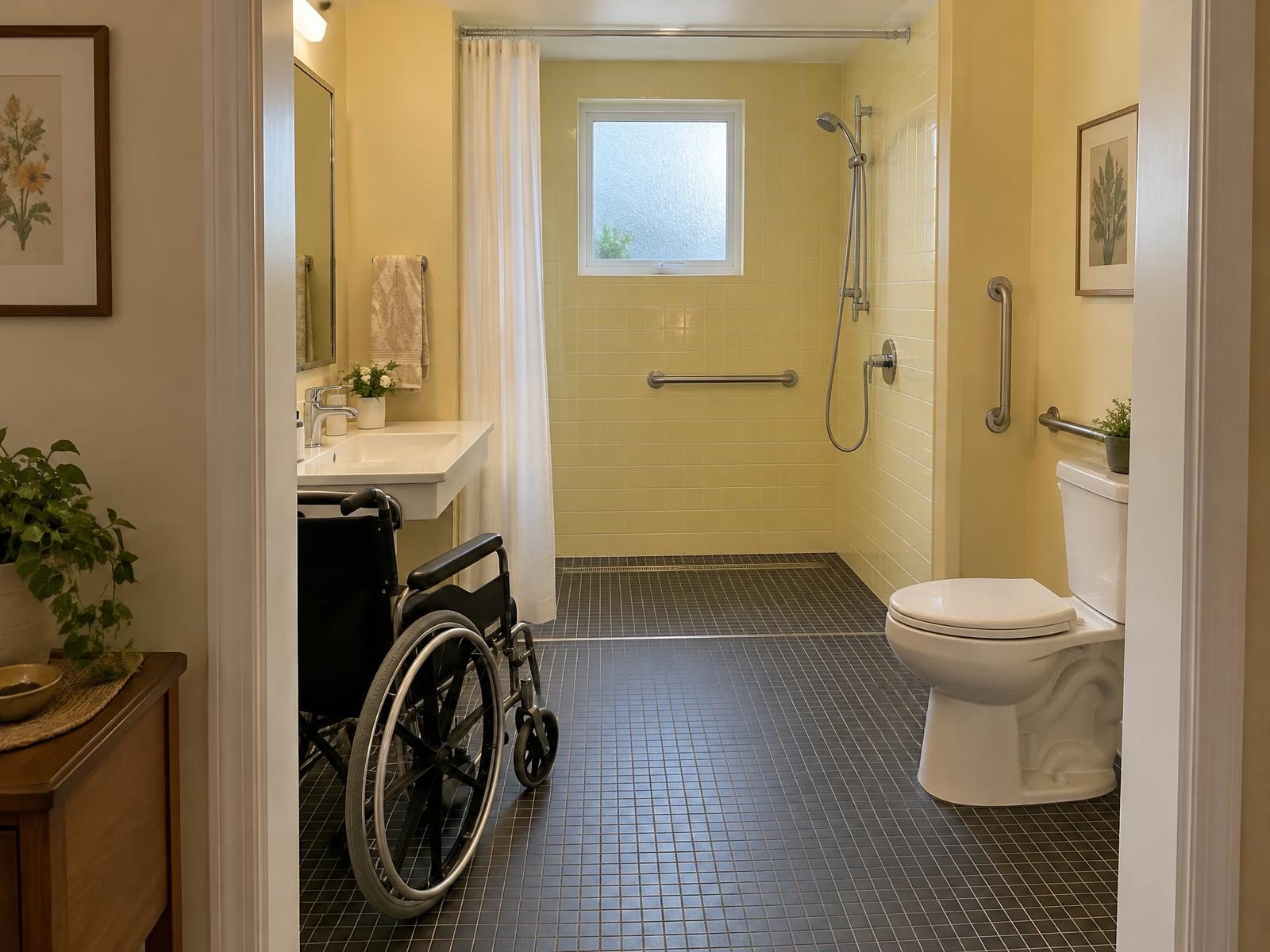
Cost vs. Value prices a universal-design bath alongside its other bathroom jobs, using a fixed description of the work. Cost vs. Value's universal-design bath job updates an existing 5-by-7-foot bathroom to be wheelchair-accessible, with a zero-threshold entry, a 36-inch-wide door and flat-panel switches 36 to 42 inches above the floor.2
| Measure | United States |
|---|---|
| Universal-design bathroom remodel, job cost | $42,1831 |
| Universal-design bathroom remodel, resale value | $25,8121 |
| Universal-design bathroom remodel, cost recouped at resale | 61%1 |
| Midrange bathroom remodel, job cost | $26,1381 |
Cost vs. Value's resale values come from an online survey of more than 6,000 Realtors, who were asked what value each project adds to a home's sale price.3 That's a buyer's view of the room. If you plan to stay, the return that counts is a bathroom you can keep using safely as your needs change, measured against the cost of moving.
Who an accessible bathroom helps
More than one in four adults 65 and older fall each year.4 The CDC says falling once doubles an older adult's chances of falling again.4 Each year, falls among adults in that age group lead to about 4,500,0004 emergency department visits, and the bathroom, with its hard, wet surfaces, is one of the rooms where getting the design right counts most.
More owners are acting on it. In 2022 and 2023, a record 3.2 million homeowners, or 3.7 percent of owners, made one or more accessibility improvements, up from 2.3 million in 2018 and 2019, according to American Housing Survey data analyzed by Harvard's Joint Center for Housing Studies.5
Older adults aren't the only ones who use these features. Someone home from surgery, a family member who uses a walker or wheelchair, and a parent bathing a small child all get more out of a level shower floor, a seat and something solid to hold.
Measurements that make the room work
Accessibility standards issued under the Americans with Disabilities Act apply to places of public accommodation, commercial facilities, and state and local government facilities, in new construction, alterations and additions.6 A private house isn't on that list, so nobody will hold your bathroom to them, but they give you and the company a written set of measurements to plan around.
Start with room to move. The ADA standards set a circular wheelchair turning space at 60 inches in diameter, and a clear floor space at 30 by 48 inches.6 Under the ADA standards a doorway needs a clear width of at least 32 inches, measured between the face of the door and the stop with the door open 90 degrees.6 In a small postwar bathroom, finding that space often means giving up the tub or rehanging the door to swing out.
Then the toilet. The ADA standards place the centerline of an accessible toilet 16 to 18 inches from the side wall.6 The ADA standards set the toilet seat height at 17 to 19 inches above the floor, and allow 15 to 19 inches in residential dwelling units.6 Placing it near a side wall puts a grab bar within reach of someone getting up or sitting down.
ADA grab bars are mounted horizontally, 33 to 36 inches above the floor measured to the top of the gripping surface.6 The space between a grab bar and the wall is set at 1½ inches.6 In residential dwelling units covered by the standards, toilet grab bars may be left out if the walls are reinforced so that bars meeting every requirement can be installed later.6 Even if nobody needs bars yet, ask for solid backing while the walls are open, so they can go up later without new tile work.
The national price above covers a specific list of features, which is useful when you compare quotes. Cost vs. Value's universal-design bath job removes the tub for a curbless, tiled walk-in shower with an adjustable showerhead, fold-out seat, thermostatic mixing valve and glass door, puts in a comfort-height toilet with a bidet-type seat, and rearranges storage so it can be reached from a seated position.2
Finding a company that has done this before
Citing the National Association of Home Builders, Harvard's Joint Center reports that 63 percent of professional remodelers installed home modifications for aging in place in 2023, and that among those doing this work, 93 percent installed grab bars, 83 percent curbless showers and 77 percent higher toilets.5 The work is common, but doing it well takes practice with clearances, shower floors that drain without a curb, and backing in the right places.
NAHB's Certified Aging-in-Place Specialist (CAPS) credential trains remodelers in home modifications for aging in place.7 Ask whether anyone on the crew holds that credential, and ask to see photos of accessible bathrooms the company has finished.
If you have fallen, the NIA notes, your doctor might suggest that an occupational therapist, physical therapist or nurse visit your home to assess its safety and advise you about changes.8 A therapist's notes on how the person moves, which side they prefer to transfer from and what they can reach make a far clearer brief for the company than a list of products.
Federal and state help with the cost
Veterans should start with the VA. The VA's Home Improvements and Structural Alterations (HISA) benefit pays for medically necessary changes to a veteran's or servicemember's primary residence, including use of essential bathroom facilities such as roll-in showers and lowering sinks and counters.9 HISA is a lifetime benefit of up to $6,800 for a service-connected disability, or for another disability when the veteran has a service-connected rating of at least 50 percent, and up to $2,000 for other disabilities.9
A HISA application needs a prescription written or approved by a VA physician, VA Form 10-0103, a written itemized estimate of labor, materials, permits and inspections, and a color photograph of the area before the work.9 The itemized estimate is something the company you hire can prepare, so mention the benefit at the first visit.
In rural areas, the USDA has a repair program that can cover safety work. USDA's Section 504 Home Repair program lends to low- and very-low-income homeowners to repair, improve or modernize their homes, and gives grants to elderly very-low-income homeowners to remove health and safety hazards.10 The maximum Section 504 loan is $40,000 and the maximum grant is $10,000, with up to $50,000 combined; loans run 20 years at a fixed 1% interest rate.10 To qualify you must own and live in the house, be unable to get affordable credit elsewhere and have a household income within the county limit, the home must be in an eligible rural area, and grant applicants must be 62 or older.10
Outside those programs, look closer to home. The National Institute on Aging says you may be able to get help paying for repairs and safety updates to your home, and suggests checking with your state housing finance agency, social services department, community development groups or the federal government.11 Many state and local governments have home modification programs to help older people prevent falls; the NIA suggests checking with your local health department or finding your Area Agency on Aging through the Eldercare Locator.8 Programs change and funds can run out, so confirm the terms in writing before you sign a contract that depends on them.
Talk through an accessible bathroom with a local company
Calls are recorded. You'll be connected to one independent company that handles accessible bath remodels in your area. We never call or text you. Privacy Policy ·Do Not Sell or Share My Personal Information
Sources
Page updated October 11, 2026. How we source our numbers
- Zonda / Journal of Light Construction, Cost vs. Value 2025, national. Released 2025. United States. Industry source.
- Zonda / Journal of Light Construction, Cost vs. Value project description: Bath Remodel | Universal Design. Released September 18, 2025. View source. Industry source.
- Zonda / Journal of Light Construction, Cost vs. Value 2025 methodology. Released September 18, 2025. View source. Industry source.
- Centers for Disease Control and Prevention, Facts About Older Adult Falls. Released September 4, 2026. View source.
- Joint Center for Housing Studies of Harvard University, Improving America's Housing 2025. Released 2025. View source. Industry source.
- U.S. Access Board, 2010 ADA Standards for Accessible Design. Released 2010. Source page, Source page, Source page, Source page.
- National Association of Home Builders, Certified Aging-in-Place Specialist (CAPS). No publication date. View source. Industry source.
- National Institute on Aging, Preventing Falls at Home: Room by Room. Released September 12, 2022. View source.
- U.S. Department of Veterans Affairs, Home Improvements and Structural Alterations (HISA). Released February 12, 2025. View source.
- USDA Rural Development, Single Family Housing Repair Loans & Grants (Section 504). Released October 1, 2026. View source.
- National Institute on Aging, Aging in Place: Growing Older at Home. Released October 12, 2023. View source.