Basement finishing in Montgomery County
Cost vs. Value's 2025 figures for the Washington, DC market put a basement remodel at $52,7571, a little above the $52,0122 national average. In Montgomery County the first local question is radon: the county falls in the EPA's highest-potential radon zone and says every home should be tested, which is far easier to act on before new walls and floors go down.
Calls are recorded. One independent company that handles basement finishing in the Montgomery County area answers.
Updated October 11, 2026
What a finished basement costs and returns here
Cost vs. Value prices one standard lower-level job in its Washington, DC market, the closest it surveys to Montgomery County. Here the job costs a little more than nationally, and agents expect more of it back at sale.
| Measure | Washington, DC market | U.S. average |
|---|---|---|
| Basement remodel, job cost | $52,7571 | $52,0122 |
| Basement remodel, resale value | $39,9541 | $36,9052 |
| Basement remodel, cost recouped at resale | 76%1 | 71%2 |
Washington-area agents value a finished lower level above the national survey, but only one that was dry to begin with. A radon system, waterproofing or a new escape window sits outside the priced job and comes on top.
Postwar basements and 1980s basements
Census counts show the county's two big building waves. A rambler or colonial from the 1950s and 1960s may have block foundation walls and small windows set high; a house from the 1980s is more likely to have poured walls and, on a sloped lot, a walk-out.
| Measure | Montgomery County | Washington metro |
|---|---|---|
| Homes built 1950–1969 | 25%3 | 20%3 |
| Homes built 1980–1989 | 19%3 | 15%3 |
Montgomery County has required all new homes to be built to resist radon entry since 1995, under Appendix F of the International Residential Code, typically with a gravel layer under the slab, a gas-tight vent pipe to the roof and a sealed foundation; a fan can be added if the passive system isn't enough.4 Neither building wave came under that rule, so only a house from the mid-1990s on should already have the vent pipe in place.
Houses and townhouses with a lower level
The Census Bureau doesn't ask whether a home has a basement. The nearest local measure is the mix of house types, and the county has more detached houses than townhouses by a wide margin.
| Measure | Montgomery County | Washington metro |
|---|---|---|
| Single-family detached homes | 47%5 | 44%6 |
| Townhouses and other attached single-family homes | 18%5 | 20%6 |
In a townhouse, the basement's only outside walls are at the front and back, which limits where an escape window and its well can go. Settle that before a bedroom is drawn.
Freezes and heavy rain in the county
NOAA keeps a long-term normals station at Rockville, near the middle of the county. Its record shows many more freezing nights than Reagan National on the river, and about as many days with an inch or more of rain.
| Measure | Rockville | Reagan National |
|---|---|---|
| Days a year with a low at or below freezing | 86 days7 | 60 days7 |
| Days a year with at least an inch of precipitation | 10 days7 | 10 days7 |
The EPA advises cleaning and repairing gutters regularly and making sure the ground slopes away from the foundation so water does not enter or collect around it.8 After the next downpour, walk around the house and watch where the water goes before deciding how much of the budget belongs to drainage.
Setting the job against the house
Half of the county's owner-occupied homes are valued above the median shown here, and that median beats the Washington metro's. A basement budget has more room in this county than in much of the region before it outgrows the house.
Permits
Finishing a basement in Montgomery County counts as an interior alteration, so it needs a building permit from the Department of Permitting Services, an electrical permit for the new circuits and a WSSC Water permit for any bathroom or wet bar. Swapping a window for one the same size needs no permit, but cutting a bigger escape opening does. The county inspects the framing before insulation goes in and checks the basement insulation and smoke detectors at the final.
- Montgomery County requires a permit before any reconstruction or renovation of an existing structure other than a repair, and reconstruction includes partial demolition and rebuilding.10
- Montgomery County's homeowner permit guide lists replacing windows and doors without changing the opening size or the net clear opening as work that needs no permit, and lists interior alterations, electrical work and replacing heating equipment as work that does.11
- In Montgomery County an electrical permit is applied for online by a master electrician licensed by the Maryland State Board of Electricians and is issued once the parent building permit has been; homeowners who qualify can instead pass a county exam to get a permit for limited work on their own home.12
- WSSC Water's plumbing and gasfitting regulations require most plumbing projects in Montgomery and Prince George's counties, including interior re-piping and all gas work, to be done by a WSSC Water-licensed plumber or gasfitter.13
- Montgomery County's framing (close-in) inspection checks framing, fire and draft stopping, air sealing of the thermal envelope and sealed trade penetrations, and must be approved before insulation is installed.14
- The county's final inspection confirms that attic, basement and crawl-space insulation is installed, smoke detectors work and the street address is posted, and it must be approved before the space is occupied or used.14
Checked October 11, 2026
Talk to a pro who handles basement finishing in Montgomery County
Calls are recorded. You'll be connected to one independent company that handles basement finishing in your area. We never call or text you. Privacy Policy ·Do Not Sell or Share My Personal Information
Radon testing comes first here
Montgomery County has been designated a Zone 1 radon area, meaning a predicted average indoor level at or above the EPA's 4.0 pCi/L action level, and the county says every home in Montgomery County should be tested for radon.15 The EPA recommends testing for radon on the lowest lived-in level, so a basement that hasn't been tested should be tested before it is remodeled; fixing a radon problem is usually easier and cheaper before the basement is finished.16
Montgomery County has required all new homes to be built to resist radon entry since 1995, under Appendix F of the International Residential Code, typically with a gravel layer under the slab, a gas-tight vent pipe to the roof and a sealed foundation; a fan can be added if the passive system isn't enough.4 In an older house, plan for the chance of an active system if the test comes back high. In a newer one, find the capped pipe and ask whether the fan should be added before the ceiling closes it in.
Since October 1, 2016, a detached house or townhome in Montgomery County must be tested for radon within the year before a sale settles, and both the seller and the buyer get a copy of the results.4 A finished basement with a recent result on file is one less question when the house goes on the market.
Keeping the lower level dry
Before turning basement space into living space, the EPA advises checking it for leaks and other signs of moisture and fixing any moisture problem first, because damp basements promote mold and other biological growth.16 Montgomery County's residential construction design parameters rate the county's risk of damage from termites as moderate to heavy and from weathering as severe.17 Wood framing against damp block invites both mold and termites, so ask how the walls will be kept off the slab and away from the foundation.
Building America advises keeping fiberglass batts and cellulose out of contact with foundation walls, and not putting polyethylene sheeting, vinyl or foil wallpaper, or epoxy, oil or alkyd paint on the inside of basement walls, because they trap moisture.18 ENERGY STAR's guidance for existing homes, based on the 2021 IECC, is R5 insulating sheathing or R13 batts on basement walls in climate zone 3, R10 sheathing or R13 batts in zones 4A and 4B, and R15 sheathing or R19 batts in zones 4C and 5 through 8.19 Have the company name the wall insulation it plans and the climate zone it designed to, and check the two against that table.
A bedroom down there needs a way out
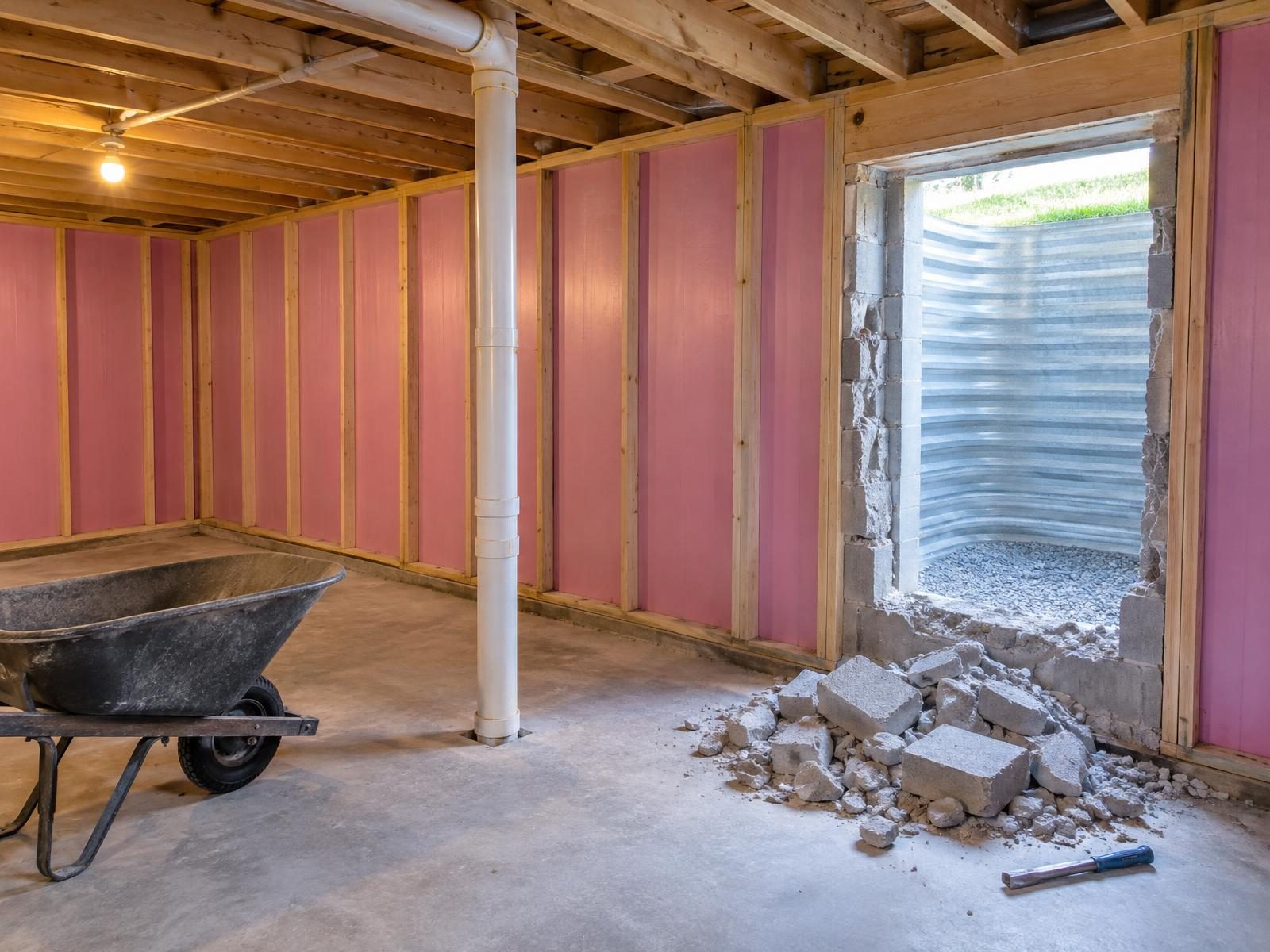
The 2021 International Residential Code requires at least one operable emergency escape and rescue opening in a basement, plus one in each sleeping room, including every bedroom in a basement.20 Under that code, an escape opening needs a net clear opening of at least 5.7 square feet, at least 24 inches high and 20 inches wide, with its bottom no more than 44 inches above the floor.20 In a postwar rambler the original basement windows are usually small and set high in the block, so a bedroom means cutting the opening down and digging a well outside.
The 2021 IRC requires habitable space and hallways, including the parts of a basement that contain them, to have a ceiling at least 7 feet high, and bathrooms and laundry rooms at least 6 feet 8 inches.20 Duct trunks and beams in older houses often hang lower than that, so measure before a bedroom is drawn around them.
Stairs and later years
More than one in four adults 65 and older fall each year.21 Basement stairs are a common place for that to happen. While the stairway is being finished, add a second handrail, light switches at top and bottom, and treads with a contrasting edge. NAHB's Certified Aging-in-Place Specialist (CAPS) credential trains remodelers in home modifications for aging in place.22
What happens when you call
When you call the number on this page, you're connected on a recorded line with one independent company that handles basement finishing in the Montgomery County area. What gets built, when, and for how much is between you and that company.
The company pays us for the call, and you pay nothing. We don't call or text you afterward. How we make money
After you're connected
Check the company with the state before paying anything. Maryland's Home Improvement Commission licenses home improvement contractors and salespersons, and its License Search shows whether a license is current.23 Check a Maryland license
Ask who will hold the building permit and the WSSC Water permit. Homeowners may apply for an alteration permit in their own name, but when a contractor does the work the county strongly suggests listing the contractor as the responsible party, and a contractor must hold a Maryland Home Improvement Commission license to obtain a permit.10
Questions people ask
What does it cost to finish a basement in Montgomery County?
Cost vs. Value's 2025 Washington, DC figure for its standard basement job is $52,7571, and area agents estimated it adds $39,9541 at resale. Waterproofing, a radon system and a new escape window are extra.
Should I test for radon before finishing the basement?
Yes, that's the order the EPA recommends. The EPA recommends testing for radon on the lowest lived-in level, so a basement that hasn't been tested should be tested before it is remodeled; fixing a radon problem is usually easier and cheaper before the basement is finished.16 Montgomery County has been designated a Zone 1 radon area, meaning a predicted average indoor level at or above the EPA's 4.0 pCi/L action level, and the county says every home in Montgomery County should be tested for radon.15
Does making a basement window bigger need a permit?
Yes, once the opening changes size. Montgomery County's homeowner permit guide lists replacing windows and doors without changing the opening size or the net clear opening as work that needs no permit, and lists interior alterations, electrical work and replacing heating equipment as work that does.11
Can I rent out the finished basement?
Not as a separate apartment without a county license. Montgomery County requires an accessory dwelling unit to be licensed whether or not it will be rented, and before it is advertised for rent.24 The county's rental conversion rules cover ceiling height, escape windows and the entrance.
Sources
Page updated October 11, 2026. How we source our numbers
- Zonda / Journal of Light Construction, Cost vs. Value 2025, Washington, DC. Released 2025. Washington, DC. Industry source.
- Zonda / Journal of Light Construction, Cost vs. Value 2025, national. Released 2025. United States. Industry source.
- U.S. Census Bureau, American Community Survey 2020–2024 5-year, table B25034. Released January 29, 2026. Montgomery County, MD, Washington-Arlington-Alexandria metro.
- Montgomery County Department of Environmental Protection, Radon and Buying or Building a Home. No publication date. View source.
- U.S. Census Bureau, American Community Survey 2020–2024 5-year, table B25024. Released January 29, 2026. Montgomery County, MD.
- U.S. Census Bureau, American Community Survey 2020-2024 5-year, Table B25024 (Units in Structure). Released January 29, 2026. Washington-Arlington-Alexandria metro.
- NOAA National Centers for Environmental Information, U.S. Climate Normals 1991–2020. Released 2021. Days a year with a low at or below freezing, Rockville 1 NE (station USC00187705), Days a year with a low at or below freezing, Reagan National Airport (station USW00013743), Days a year with at least an inch of precipitation, Rockville 1 NE (station USC00187705), Days a year with at least an inch of precipitation, Reagan National Airport (station USW00013743).
- U.S. Environmental Protection Agency, A Brief Guide to Mold, Moisture and Your Home. Released February 18, 2026. View source.
- U.S. Census Bureau, American Community Survey 2020–2024 5-year, table B25077. Released January 29, 2026. Montgomery County, MD, Washington-Arlington-Alexandria metro.
- Montgomery County Department of Permitting Services, Residential Alterations Permit Process. No publication date. View source.
- Montgomery County Department of Permitting Services, A Guide to Building Permits and Home Improvements (Permits Required / No Permits Required). No publication date. View source.
- Montgomery County Department of Permitting Services, Electrical Permit with Parent Building permit process. No publication date. View source.
- WSSC Water, Permit Services: Information for Homeowners. Released May 2, 2023. View source.
- Montgomery County Department of Permitting Services, Residential Alterations Building Inspections (Building Inspection Sequence). Released April 2026. View source.
- Montgomery County Department of Environmental Protection, Radon. No publication date. View source.
- U.S. Environmental Protection Agency, Remodeling Your Home and Indoor Air Quality. Released February 17, 2026. View source.
- Montgomery County Department of Permitting Services, Residential Construction Design Parameters. No publication date. View source.
- U.S. Department of Energy, Building America Top Innovations: Basement Insulation Systems. No publication date. View source.
- ENERGY STAR (U.S. EPA and U.S. DOE), Recommended Home Insulation R-Values. No publication date. View source.
- International Code Council, 2021 International Residential Code, Chapter 3 Building Planning. Released 2021. View source. Industry source.
- Centers for Disease Control and Prevention, Facts About Older Adult Falls. Released September 4, 2026. View source.
- National Association of Home Builders, Certified Aging-in-Place Specialist (CAPS). No publication date. View source. Industry source.
- Maryland Department of Labor, Maryland Home Improvement Commission. No publication date. View source.
- Montgomery County Department of Housing and Community Affairs, Class 3 Accessory Dwelling Unit (application process and requirements). Released September 4, 2025. View source.