Rental conversions in Montgomery County
Cost vs. Value's 2025 figure for a new detached accessory dwelling unit in the Washington, DC market is $164,6341, and it publishes no price for converting a basement or attic you already have. In Montgomery County the bigger factor is the license: every accessory apartment must be licensed and inspected by the county's housing department whether or not it is rented, and the owner has to live on the property.
Calls are recorded. One independent company that handles rental conversions in the Montgomery County area answers.
Updated October 11, 2026
The one accessory unit Cost vs. Value prices
The report's accessory unit is a new detached cottage, not a converted basement, and its Washington, DC market is the nearest one to the county. In this market it costs slightly less to build than nationally and is valued higher at resale.
| Measure | Washington, DC market | U.S. average |
|---|---|---|
| Accessory dwelling unit (new detached build), job cost | $164,6341 | $166,4062 |
| Accessory dwelling unit (new detached build), resale value | $74,7001 | $68,6562 |
A conversion reuses a foundation, walls and roof that the cottage has to pay for, so treat this figure as a reference point rather than an estimate for your house. The county's license rules, further down, decide what the converted space must include.
What renters pay here
Median gross rent is the monthly rent plus the utilities a tenant pays on top. Montgomery County's median runs a little above the Washington metro's.
How many households rent
About a third of the county's occupied homes are rented, a slightly smaller share than across the metro.
Which houses can take an accessory unit
The county allows an accessory unit only on a lot with a detached single-family house, so the house-type mix decides who can consider one at all.
| Measure | Montgomery County | Washington metro |
|---|---|---|
| Single-family detached homes | 47%5 | 44%6 |
| Townhouses and other attached single-family homes | 18%5 | 20%6 |
An accessory dwelling unit in Montgomery County must be on a single-family detached property, not in a townhouse, condominium, duplex or mobile home, and either the main house or the accessory unit must be the owner's primary residence.7
Houses built before the lead rules
Federal and state lead rules turn on whether a house was built before 1978. Census groups homes by decade, so the closest count is homes built before 1980.
| Measure | Montgomery County | Washington metro |
|---|---|---|
| Homes built before 1980 | 49%8 | 45%8 |
If the house was built before January 1, 1978, the accessory dwelling unit must be registered with the Maryland Department of the Environment and pass a lead paint inspection by an accredited inspector before the county issues the license.7
Permits
A rental conversion in Montgomery County runs through two county departments. The Department of Permitting Services issues the building permit, while the Department of Housing and Community Affairs licenses and inspects the unit, and its preliminary inspection has to happen before construction starts. WSSC Water permits the plumbing for the new kitchen and bath. Rockville and Gaithersburg issue their own permits, so the county process may not apply there.
- Montgomery County, Maryland, requires a building permit for every ADU, and the main house or the accessory apartment must be the applicant's primary residence to get a rental license.9
- In Montgomery County, all accessory dwelling units are licensed and inspected by the Department of Housing and Community Affairs, which issues all rental licenses.10
- Construction, alteration or renovation for an accessory dwelling unit can't start before DHCA's preliminary inspection report is complete, and any open permits must be finalized before the license is issued; plumbing permits come from WSSC Water.7
- Montgomery County requires an accessory dwelling unit to be licensed whether or not it will be rented, and before it is advertised for rent.7
- WSSC Water's plumbing and gasfitting regulations require most plumbing projects in Montgomery and Prince George's counties, including interior re-piping and all gas work, to be done by a WSSC Water-licensed plumber or gasfitter.11
- The cities of Rockville and Gaithersburg issue their own permits instead of the county, and several towns, including Takoma Park, Kensington and Chevy Chase Village, require their own approval along with the county permit.12
Checked October 11, 2026
Talk to a pro who handles rental conversions in Montgomery County
Calls are recorded. You'll be connected to one independent company that handles rental conversions in your area. We never call or text you. Privacy Policy ·Do Not Sell or Share My Personal Information
What the county requires of an accessory apartment
An attached accessory dwelling unit may have up to 1,200 square feet of gross floor area, including cellar space, or the full square footage of the basement or cellar if only that level is used; a detached one is limited to the least of 50% of the main house's footprint, 10% of the lot area or 1,200 square feet.7 The accessory dwelling unit must be the only additional living unit on the lot, with no other tenants, boarders or short-term rentals such as Airbnb, and no more than two adults may live in it.7
With an existing driveway, an accessory dwelling unit needs one on-site parking space beyond what the main house requires, or two spaces if a new driveway must be built; no on-site space is required within one mile of a Metrorail, Purple Line or MARC station.7 Check the walking distance to the nearest Metrorail, Purple Line or MARC station before you plan a new driveway.
The unit needs a separate entrance on the side or rear of the house that leads directly outside and not through a garage; a front entrance is allowed only if it is shared with the main house or the unit's front door existed before May 20, 2013.7 The unit's entrance door must be side-hinged with a clear width of at least 32 inches and a clear height of at least 78 inches, and double-cylinder deadbolts must be replaced with thumb-turn deadbolts.7
The Class 3 accessory dwelling unit application fee is $615: a $260 filing fee, a $230 public notice sign fee and a $125 annual license fee.7 DHCA checks an accessory dwelling unit application for completeness within 5 business days, the owner must post a public notice sign for at least 30 days, and the license is approved 30 days after the Director's report if the unit complies.7
Turning a basement into the unit
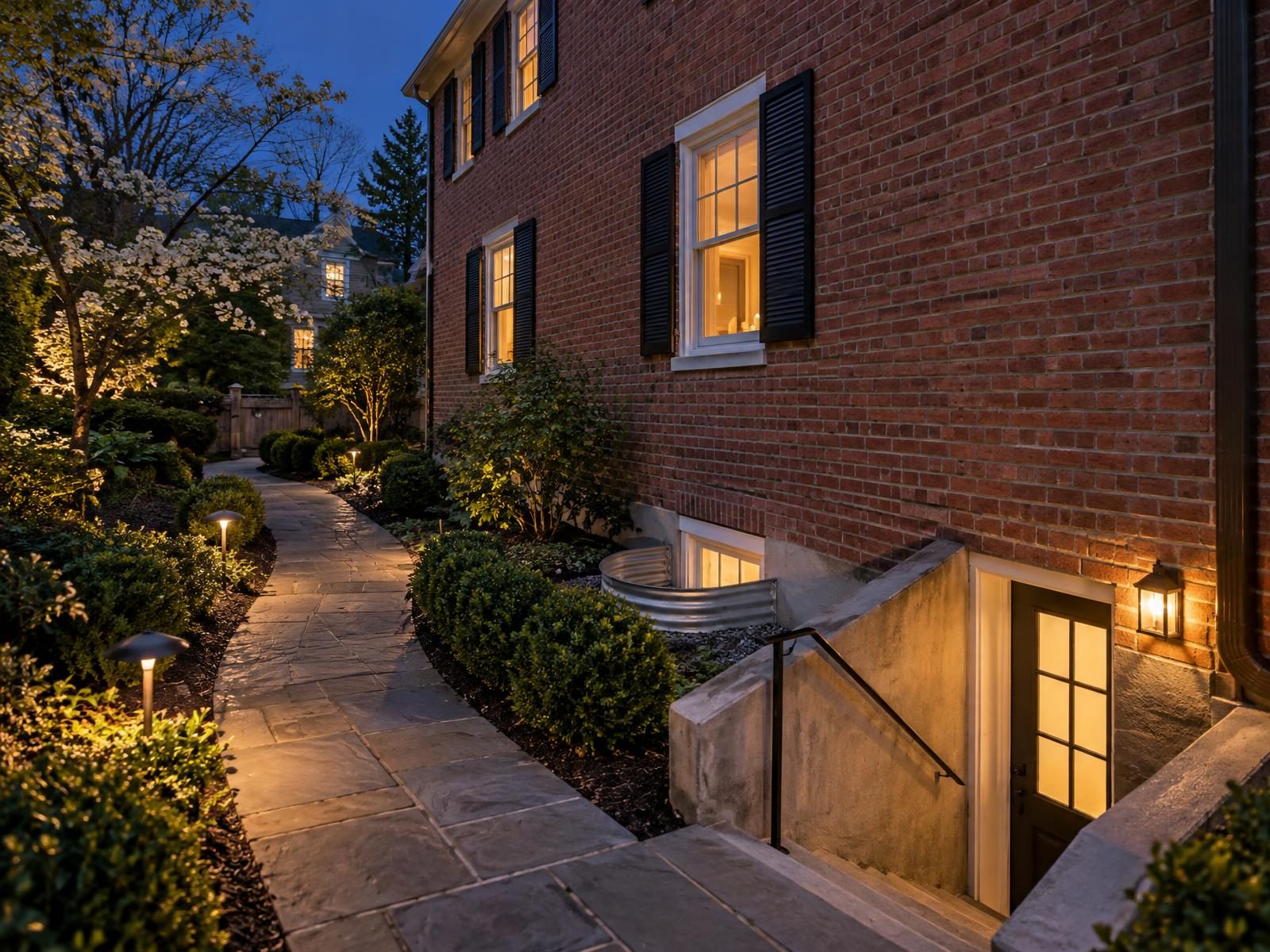
An accessory dwelling unit in a finished basement or cellar needs a ceiling at least 6 feet 8 inches high, with beams, girders, ducts or other obstructions allowed down to 6 feet 4 inches, and the ceiling must be finished drywall.7 Every sleeping room in the unit needs an operable window or exterior door for emergency escape; a window at or below grade needs at least 5 square feet of net clear opening, at least 24 inches high and 20 inches wide, with the opening no more than 44 inches above the floor.7
A basement stairway used as the unit's exit must be at least 36 inches wide, or 32 inches if existing, a furnace may not sit under it, and a sleeping room next to a utility room with a fuel-burning furnace or water heater needs a weather-stripped, self-closing door between them.7 The unit's kitchen needs a stove at least 24 inches wide, a standard refrigerator and a 36-inch clear passageway, its cooking area needs two circuits of at least 20 amps, and bathroom outlets must be GFI-protected on a 20-amp circuit.7
Carbon monoxide alarms are required in all rental dwelling units, whether or not they have fuel-burning equipment, outside each sleeping area and on every occupiable level including basements.7 The U.S. Fire Administration says homeowners and landlords should put smoke alarms in every bedroom, outside each sleeping area and on every level, test them monthly, and replace them 10 years from their manufacture date.13
Rules that come with renting
Single-family and condominium owners in Montgomery County who rent out their property must get a rental housing license every year, and rental properties built before 1978 must meet Maryland's lead poisoning risk reduction requirements.14 Since July 1, 2023, Montgomery County law has required radon testing in single-family and multifamily rental housing, including condominiums, with disclosure and mitigation of radon above an action level, administered by DHCA.15
EPA's lead renovation rule generally doesn't cover homeowners working on their own pre-1978 homes, but it does apply if you rent out all or part of your home.16 Before a renter signs a lease for most pre-1978 housing, federal law requires the landlord to disclose known lead-based paint and hazards, share available records, hand over EPA's Protect Your Family From Lead pamphlet and include a Lead Warning Statement.17
Montgomery County's Zoning Text Amendment 19-01, in effect since December 31, 2019, removed the requirement for conditional use approval for accessory apartments and allows detached accessory dwelling units as a limited use in the R-200, R-90 and R-60 zones.10 Older special-exception apartments follow different paperwork, so ask the county which license yours falls under if the unit already exists.
A unit for a parent rather than a tenant
More than one in four adults 65 and older fall each year.18 Some owners build an accessory apartment for a parent instead of a renter, and the county's license applies either way. A step-free path from the parking space, a curbless shower and lever handles cost little more when they're in the first drawings. NAHB's Certified Aging-in-Place Specialist (CAPS) credential trains remodelers in home modifications for aging in place.19
What happens when you call
Calling the number on this page puts you through, on a recorded line, to one independent company that handles rental conversions in the Montgomery County area. The design, the schedule and the price are agreed between you and that company.
The company pays us for each call, so connecting costs you nothing, and nobody from our side calls or texts you afterward. How we make money
After you're connected
Look the company up with the state before any money changes hands. Maryland's Home Improvement Commission licenses home improvement contractors and salespersons, and its License Search shows whether a license is current.20 Check a Maryland license
Then ask who will pull the building permit, and line it up with the county's preliminary inspection. Homeowners may apply for an alteration permit in their own name, but when a contractor does the work the county strongly suggests listing the contractor as the responsible party, and a contractor must hold a Maryland Home Improvement Commission license to obtain a permit.21
Questions people ask
Can I rent out my basement in Montgomery County?
Yes, if the house qualifies and the space is licensed as an accessory dwelling unit. An accessory dwelling unit in Montgomery County must be on a single-family detached property, not in a townhouse, condominium, duplex or mobile home, and either the main house or the accessory unit must be the owner's primary residence.7
Do I need a parking space for an accessory apartment?
With an existing driveway, an accessory dwelling unit needs one on-site parking space beyond what the main house requires, or two spaces if a new driveway must be built; no on-site space is required within one mile of a Metrorail, Purple Line or MARC station.7
What does the county license cost?
The Class 3 accessory dwelling unit application fee is $615: a $260 filing fee, a $230 public notice sign fee and a $125 annual license fee.7 Permit fees for the construction itself are separate.
Can I list the unit as a short-term rental?
No. The accessory dwelling unit must be the only additional living unit on the lot, with no other tenants, boarders or short-term rentals such as Airbnb, and no more than two adults may live in it.7
Sources
Page updated October 11, 2026. How we source our numbers
- Zonda / Journal of Light Construction, Cost vs. Value 2025, Washington, DC. Released 2025. Washington, DC. Industry source.
- Zonda / Journal of Light Construction, Cost vs. Value 2025, national. Released 2025. United States. Industry source.
- U.S. Census Bureau, American Community Survey 2020–2024 5-year, table B25064. Released January 29, 2026. Montgomery County, MD, Washington-Arlington-Alexandria metro.
- U.S. Census Bureau, American Community Survey 2020–2024 5-year, table B25003. Released January 29, 2026. Montgomery County, MD.
- U.S. Census Bureau, American Community Survey 2020–2024 5-year, table B25024. Released January 29, 2026. Montgomery County, MD.
- U.S. Census Bureau, American Community Survey 2020-2024 5-year, Table B25024 (Units in Structure). Released January 29, 2026. Washington-Arlington-Alexandria metro.
- Montgomery County Department of Housing and Community Affairs, Class 3 Accessory Dwelling Unit (application process and requirements). Released September 4, 2025. View source.
- U.S. Census Bureau, American Community Survey 2020–2024 5-year, table B25034. Released January 29, 2026. Montgomery County, MD, Washington-Arlington-Alexandria metro.
- Montgomery County, Maryland, Department of Permitting Services, Zoning and Permitting Requirements for Accessory Dwelling Units (ADUs). Released April 2026. View source.
- Montgomery County Department of Permitting Services, Zoning and Permitting Requirements for Accessory Dwelling Units (ADUs). Released April 2026. View source.
- WSSC Water, Permit Services: Information for Homeowners. Released May 2, 2023. View source.
- Montgomery County Department of Permitting Services, Municipalities Page. No publication date. View source.
- U.S. Fire Administration (FEMA), Smoke Alarms. No publication date. View source.
- Montgomery County Department of Housing and Community Affairs, Licensing and Registration. No publication date. View source.
- Montgomery County Department of Environmental Protection, Radon. No publication date. View source.
- U.S. Environmental Protection Agency, Lead Renovation, Repair and Painting Program. Released June 17, 2026. View source.
- U.S. Environmental Protection Agency, Real Estate Disclosures about Potential Lead Hazards. Released May 27, 2026. View source.
- Centers for Disease Control and Prevention, Facts About Older Adult Falls. Released September 4, 2026. View source.
- National Association of Home Builders, Certified Aging-in-Place Specialist (CAPS). No publication date. View source. Industry source.
- Maryland Department of Labor, Maryland Home Improvement Commission. No publication date. View source.
- Montgomery County Department of Permitting Services, Residential Alterations Permit Process. No publication date. View source.