Accessible bathrooms in Prince George's County
Cost vs. Value's 2025 Washington, DC figures put a universal-design bathroom at $41,8321, close to the $42,1832 national figure. In Prince George's County the local factor is need: 21%3 of the county's older residents have serious difficulty walking or climbing stairs, and both the county and the state offer loans that can cover grab bars, ramps and a curbless shower.
Calls are recorded. One independent company that handles accessible bathrooms in the Prince George's County area answers.
Updated October 11, 2026
What the remodel costs and returns
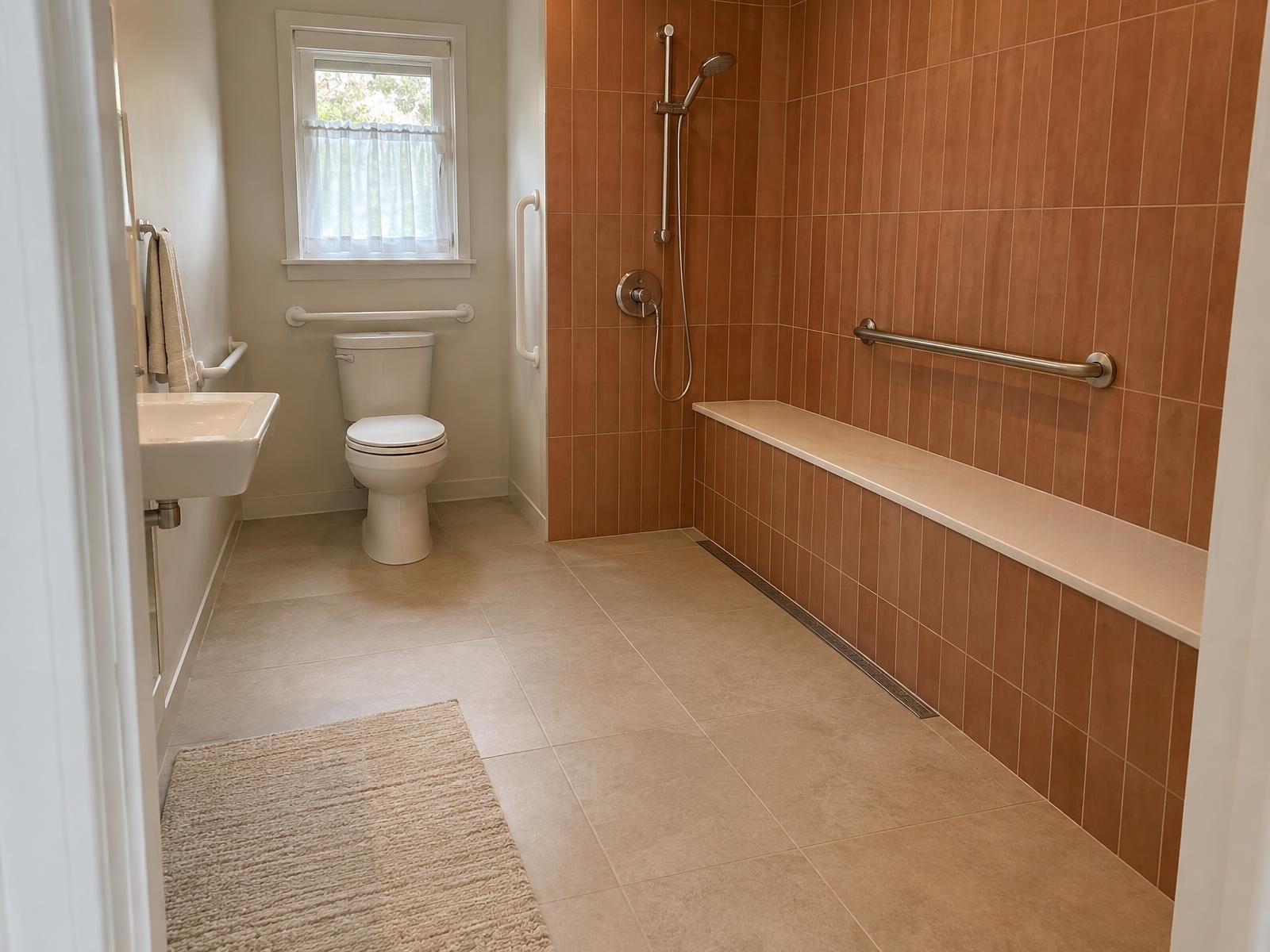
The report's universal-design job swaps the tub for a curbless shower, widens the door and puts controls within reach. These are its 2025 Washington, DC numbers against the national averages, since Prince George's County has no market of its own in the report.
| Measure | Washington, DC market | U.S. average |
|---|---|---|
| Universal-design bathroom remodel, job cost | $41,8321 | $42,1832 |
| Universal-design bathroom remodel, resale value | $25,9921 | $25,8122 |
| Universal-design bathroom remodel, cost recouped at resale | 62%1 | 61%2 |
Resale only returns part of the cost, so design this room around the person who will use it, not a future buyer.
Owners past retirement age
Census counts show a larger share of the county's owner-occupied homes headed by an older householder than across the Washington metro, and a slightly larger share headed by the oldest owners.
| Measure | Prince George's County | Washington metro |
|---|---|---|
| Owner-occupied homes headed by someone 65 or older | 31%4 | 27%4 |
| Owner-occupied homes headed by someone 75 or older | 11%4 | 11%4 |
For an owner who intends to stay, the bathroom is often the first room worth reworking, because it combines wet floors, tight turns and a tub edge to step over.
Trouble with walking and stairs
The Census Bureau asks whether people have serious difficulty walking or climbing stairs. Among the county's older residents, the share who do is higher than across the metro.
| Measure | Prince George's County | Washington metro |
|---|---|---|
| Residents 65 and older with serious difficulty walking or climbing stairs, share | 21%3 | 18%3 |
| Residents 65 and older with serious difficulty walking or climbing stairs | 28,8003 | – |
In a split-level, every trip from the bedrooms to the front door involves stairs, which is why some owners add a full bath on the entry level rather than rebuild the one upstairs.
Bathrooms from the building boom
More than half the county's homes went up before 1980, and its busiest building decade was the 1960s, when hall baths were usually compact rooms built around a tub.
| Measure | Prince George's County | Washington metro |
|---|---|---|
| Homes built before 1980 | 54%5 | 45%5 |
| Homes built 1960–1969 | 18%5 | 11%5 |
Under the ADA standards a doorway needs a clear width of at least 32 inches, measured between the face of the door and the stop with the door open 90 degrees.6 Older interior doors often fall short of that, so measure the bathroom door early; widening it can mean moving a switch or reframing part of the wall.
One floor or several
Detached houses are close to half the county's homes. Townhouses make up a smaller share, and in many of them the full baths are all on the upper floor, which limits what an accessible remodel can do there.
Permits
Rebuilding a hall bath for accessibility in unincorporated Prince George's County usually takes a DPIE building permit for the alteration, an electrical permit from a licensed electrician for new lights or outlets, and a WSSC Water plumbing permit when the shower drain or toilet moves. Replacing a toilet or vanity in its existing spot can skip the plumbing permit. Ramps and one-floor interior remodels without structural work can go through the county's virtual walk-through permit process.
- Prince George's County treats any construction or renovation of an existing structure, other than a repair or an addition, as an alteration, and some alteration projects need more than one permit.8
- In Prince George's County, replacing existing plumbing fixtures generally doesn't need a permit, except for water heaters and testable backflow devices.9
- WSSC Water's code needs no plumbing permit to replace a fixture or appliance of the same kind in the same place without altering the rough-in piping, but requires a short form permit to install one for the first time on existing piping and a long form permit to modify, extend or relocate plumbing.10
- Prince George's County's permit chart lists replacing electrical wiring and relocating switches, outlets, lighting fixtures or sub-panels as work that needs an electrical permit, which only a licensed electrical contractor can obtain.11
- DPIE's virtual walk-through permit process for homeowners covers basement finishing, new or replacement ramps and one-level interior remodeling without load-bearing structural work, but not homes served by a private well or septic system.12
- Prince George's County building permits are applied for online through the Momentum portal, and an interior alteration application needs structural and architectural drawings plus the county's plan screen checklist for residential projects.8
Checked October 11, 2026
Talk to a pro who handles accessible bathrooms in Prince George's County
Calls are recorded. You'll be connected to one independent company that handles accessible bathrooms in your area. We never call or text you. Privacy Policy ·Do Not Sell or Share My Personal Information
County and state help with the cost
Prince George's County's Housing Rehabilitation Assistance Program offers owner-occupants within its income limits loans of up to $60,000 at 0% interest with no monthly payment for health and safety repairs, including ADA-related improvements such as ramps, grab bars and railings.13 The county's Home Ownership Preservation Program, run with Habitat for Humanity of Metro Maryland, provides up to $30,000 for health, safety, energy and accessibility repairs, or up to $50,000 in services for households under 50% of area median income.13
Maryland's Accessible Homes for Seniors program serves owner-occupants with at least one resident 55 or older whose household income is no more than 80% of the statewide or Washington, DC metro median.14 The program makes zero-interest loans deferred for 30 years, or grants of up to $25,000 for applicants who don't qualify for a loan, for changes such as widening doorways, accessible showers, ramps, grab bars and lever handles; applications are available from local county housing offices and Maryland Access Point agencies.14
Each program sets its own steps for approving the scope and paying the contractor, so ask how that works before any work starts rather than after the room is finished.
Fitting the room into a rambler or split-level
More than one in four adults 65 and older fall each year.15 The CDC says falling once doubles an older adult's chances of falling again.15 In a rambler the bath already sits on the main floor, so the work stays inside the room: a curbless shower, a comfort-height toilet and bars where hands naturally reach.
The federal ADA accessibility standards note that a shower stall at least 60 inches wide with no curb can make a whole bathroom more usable, because the shower area adds maneuvering space.6 The ADA standards limit the threshold of a roll-in shower to 1/2 inch high.6 A compact hall bath may have to borrow space from a linen closet to reach that width.
In residential dwelling units covered by the standards, toilet grab bars may be left out if the walls are reinforced so that bars meeting every requirement can be installed later.6 Solid blocking set behind new tile now means bars can go up later without opening the wall again. NAHB's Certified Aging-in-Place Specialist (CAPS) credential trains remodelers in home modifications for aging in place.16
The county's new universal design rule
Beginning July 1, 2026, Prince George's County requires certain newly built homes, including single-family detached and attached, two-family and three-family dwellings, to include universal design features; existing homes do not have to be retrofitted.17 A house being remodeled isn't covered by it, so the accessible features in your bath come down to what you and the company write into the plan.
What happens when you call
Call the number on this page and the recorded line connects you with one independent company that handles accessible bathroom remodels in the Prince George's County area. The layout, the fixtures and the price are settled between you and them.
We're paid by that company for the call; it costs you nothing, and no one from our side will call or text you afterward. How we make money
After you're connected
Search the company in Maryland's license records before the first visit. Maryland's Home Improvement Commission licenses home improvement contractors and salespersons, and its License Search shows whether a license is current.18 Check a Maryland license
If a county or state loan is paying for part of the job, tell the company at the start. Prince George's County says that unless the homeowner does the work, every home improvement project must use a contractor licensed by the Maryland Home Improvement Commission, and a home in a subdivision with a homeowners association may also need the association's approval.8
Questions people ask
How much does a universal-design bathroom cost in Prince George's County?
The 2025 Cost vs. Value report priced the job at $41,8321 in the Washington, DC market, with $25,9921 of it estimated to come back at resale. Grab bars, a hand shower and a raised toilet on their own make a much smaller project.
Does the county help pay for accessibility changes?
It can, through a loan rather than a grant. Prince George's County's Housing Rehabilitation Assistance Program offers owner-occupants within its income limits loans of up to $60,000 at 0% interest with no monthly payment for health and safety repairs, including ADA-related improvements such as ramps, grab bars and railings.13
Do I need a permit to build a ramp?
Yes. A new or replacement ramp is one of the permit types DPIE handles through its virtual walk-through. DPIE's virtual walk-through permit process for homeowners covers basement finishing, new or replacement ramps and one-level interior remodeling without load-bearing structural work, but not homes served by a private well or septic system.12
Does the county's universal design law apply to my remodel?
No. Beginning July 1, 2026, Prince George's County requires certain newly built homes, including single-family detached and attached, two-family and three-family dwellings, to include universal design features; existing homes do not have to be retrofitted.17
Sources
Page updated October 11, 2026. How we source our numbers
- Zonda / Journal of Light Construction, Cost vs. Value 2025, Washington, DC. Released 2025. Washington, DC. Industry source.
- Zonda / Journal of Light Construction, Cost vs. Value 2025, national. Released 2025. United States. Industry source.
- U.S. Census Bureau, American Community Survey 2020–2024 5-year, table S1810. Released January 29, 2026. Prince George's County, MD, Washington-Arlington-Alexandria metro.
- U.S. Census Bureau, American Community Survey 2020–2024 5-year, table B25007. Released January 29, 2026. Prince George's County, MD, Washington-Arlington-Alexandria metro.
- U.S. Census Bureau, American Community Survey 2020–2024 5-year, table B25034. Released January 29, 2026. Prince George's County, MD, Washington-Arlington-Alexandria metro.
- U.S. Access Board, 2010 ADA Standards for Accessible Design. Released 2010. Source page, Source page, Source page.
- U.S. Census Bureau, American Community Survey 2020-2024 5-year, Table B25024 (Units in Structure). Released January 29, 2026. Prince George's County, MD.
- Prince George's County Department of Permitting, Inspections and Enforcement, Residential Building Permits: Alteration. No publication date. View source.
- Prince George's County Department of Permitting, Inspections and Enforcement, Residential Building Permits: Plumbing. No publication date. View source.
- WSSC Water, 2024 WSSC Plumbing and Fuel Gas Code (Amendment 1). Released February 2, 2026. View source.
- Prince George's County Department of Permitting, Inspections and Enforcement, When Is a Permit Required?. No publication date. View source.
- Prince George's County Department of Permitting, Inspections and Enforcement, Permit Types and Virtual Walk-Through Instructions (flyer). No publication date. View source.
- Prince George's County Department of Housing and Community Development, Housing Rehabilitation Assistance Programs. No publication date. View source.
- Maryland Department of Housing and Community Development, Accessible Homes for Seniors. No publication date. View source.
- Centers for Disease Control and Prevention, Facts About Older Adult Falls. Released September 4, 2026. View source.
- National Association of Home Builders, Certified Aging-in-Place Specialist (CAPS). No publication date. View source. Industry source.
- Prince George's County Department of Permitting, Inspections and Enforcement, Universal Design Now in Effect July 1, 2026. No publication date. View source.
- Maryland Department of Labor, Maryland Home Improvement Commission. No publication date. View source.