Whole-home remodeling in Prince George's County
A full renovation in Prince George's County gets priced one project at a time: Cost vs. Value's 2025 Washington, DC figures put a major midrange kitchen at $79,9881, a midrange bath at $25,9361 and a switch to electric heating at $20,2781. The local factor that moves the total is age, since 54%2 of the county's homes went up before 1980, so wiring, ductwork and drain lines often come due along with the new finishes.
Calls are recorded. One independent company that handles whole-home remodels in the Prince George's County area answers.
Updated October 11, 2026
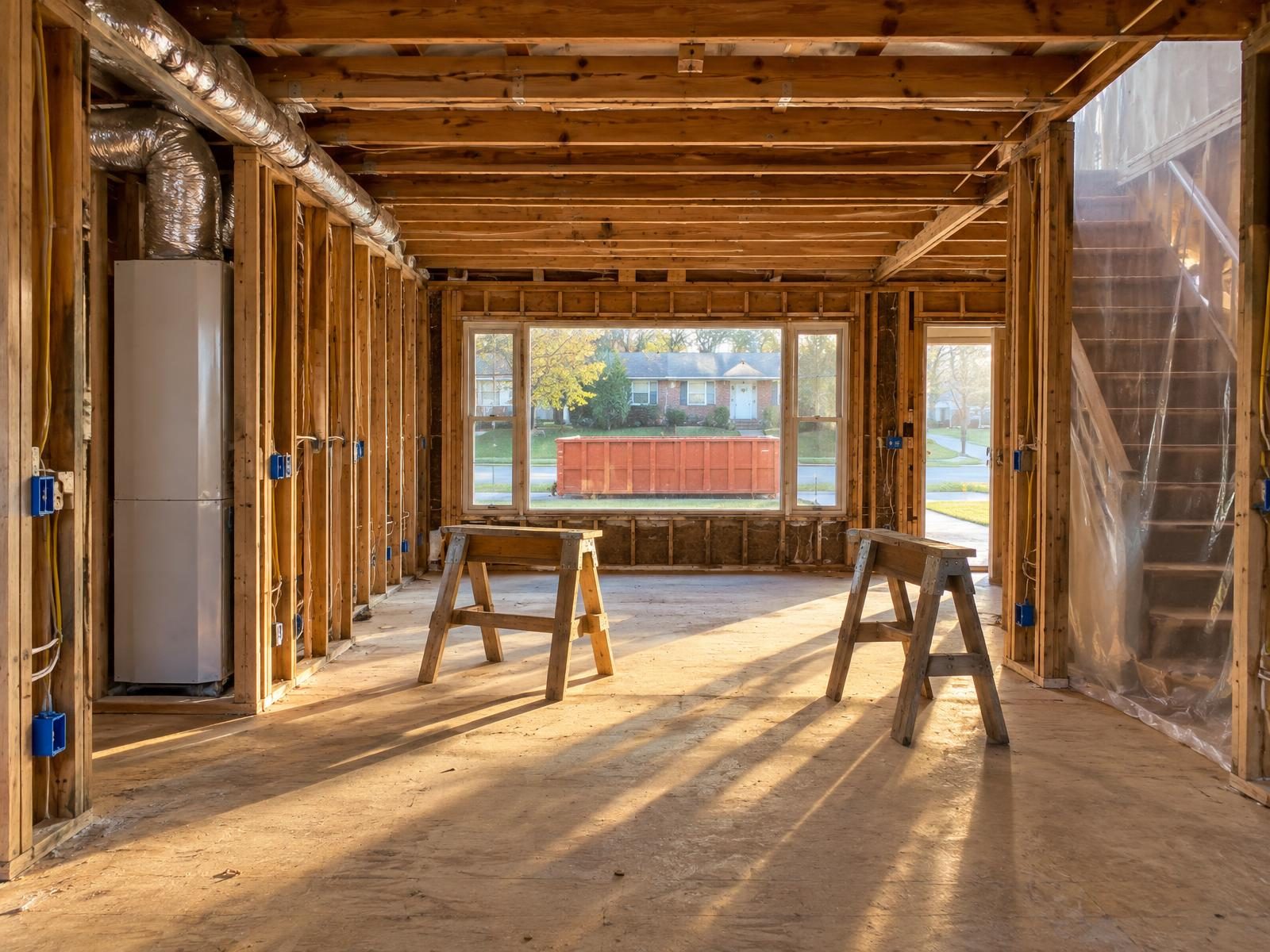
Adding up the rooms
Cost vs. Value has no project for gutting an entire house, and no market for Prince George's County. Its 2025 Washington, DC page prices the separate jobs a full renovation usually strings together, listed here beside the national numbers.
| Measure | Washington, DC market | U.S. average |
|---|---|---|
| Major kitchen remodel, midrange, job cost | $79,9881 | $82,7933 |
| Midrange bathroom remodel, job cost | $25,9361 | $26,1383 |
| Basement remodel, job cost | $52,7571 | $52,0123 |
| HVAC conversion (electrification), job cost | $20,2781 | $19,4841 |
Keep every row as its own line in the contract. In an older county house, the heating and electrical lines can come close to the kitchen line, so get them priced before anyone picks tile.
When the county did its building
Prince George's County put up a large share of its housing in the twenty years after 1950. Homes from the 1960s alone make up a far bigger slice of the county's stock than of the Washington metro's.
| Measure | Prince George's County | Washington metro |
|---|---|---|
| Homes built before 1980 | 54%2 | 45%2 |
| Homes built 1950–1969 | 30%2 | 20%2 |
| Homes built 1960–1969 | 18%2 | 11%2 |
A house from those decades was wired, piped and insulated for the loads and codes of its day. When walls open in several rooms at once, plan to bring those systems forward instead of patching around them.
Freestanding houses and townhouse rows
Close to half the county's homes stand on their own lots, a bigger share than across the metro, while townhouses are a smaller part of the mix. What a house shares with its neighbors shapes how a full renovation can be staged.
| Measure | Prince George's County | Washington metro |
|---|---|---|
| Single-family detached homes | 49%4 | 44%4 |
| Townhouses and other attached single-family homes | 17%4 | 20%4 |
Prince George's County says that unless the homeowner does the work, every home improvement project must use a contractor licensed by the Maryland Home Improvement Commission, and a home in a subdivision with a homeowners association may also need the association's approval.5 In a townhouse row, ask the association about dumpster spots, work hours and exterior changes before a start date is set.
Gas, electric and the heating decision
Utility gas heats a slightly larger share of occupied homes in the county than in the metro, and electricity a slightly smaller one. A gut renovation is the natural moment to decide whether the house keeps burning gas.
| Measure | Prince George's County | Washington metro |
|---|---|---|
| Homes heated with utility gas | 53%6 | 48%6 |
| Homes heated with electricity | 41%6 | 45%6 |
The county's permit chart lists installing a heat pump or electric air conditioning as needing electrical and mechanical permits, and a gas furnace as needing electrical, mechanical and plumbing or gas permits; only a licensed electrical or mechanical contractor can obtain those trade permits.7 Trading a gas furnace for a heat pump changes which trades pull permits, so settle the heating plan before the electrical drawings are final.
How far the house value stretches
The median owner-occupied home in Prince George's County is worth well under the metro median. That narrows the gap between what a full renovation costs and what the finished house could sell for.
The trades on a long job
BLS reports these medians for the Washington metro as a whole and publishes none for the county. Carpenters set the pace on a whole-house job, while electricians and plumbers come back for each round of rough-in work.
| Measure | Washington metro | United States |
|---|---|---|
| Carpenters, median hourly wage | $29.23/hr9 | $29.12/hr9 |
| Electricians, median hourly wage | $36.50/hr9 | $30.38/hr9 |
| Plumbers, median hourly wage | $34.55/hr9 | $30.67/hr9 |
WSSC Water's plumbing and gasfitting regulations require most plumbing projects in Montgomery and Prince George's counties, including interior re-piping and all gas work, to be done by a WSSC Water-licensed plumber or gasfitter.10 Confirm the plumber's WSSC Water license before the first rough-in goes on the calendar.
Permits
A whole-house job in unincorporated Prince George's County stacks several permits. DPIE issues the building permit for the alteration, with drawings attached, while licensed electrical and mechanical contractors pull their own trade permits and WSSC Water permits any plumbing or gas line that moves. Larger changes raise the bar, from plans for a relocated stair to sprinklers when an addition outgrows the original house, and many towns in the county want a permit of their own as well.
- Prince George's County treats any construction or renovation of an existing structure, other than a repair or an addition, as an alteration, and some alteration projects need more than one permit.5
- Prince George's County building permits are applied for online through the Momentum portal, and an interior alteration application needs structural and architectural drawings plus the county's plan screen checklist for residential projects.5
- Relocating stairs and building dormers each need a building permit and plans under the county's permit chart.7
- Electrical work for an alteration of an existing home in Prince George's County needs an electrical permit applied for by a master electrician licensed by the State of Maryland.5
- Prince George's County mechanical permits are applied for online in the Momentum system by a master HVACR contractor licensed by Maryland who has registered with the county.11
- DPIE doesn't review plumbing plans or issue plumbing permits; all plumbing permits in Prince George's County are issued by WSSC Water, which also handles plumbing inspections.12
- In Prince George's County, every addition to a home that has a sprinkler system, including sunrooms and patio enclosures, must also be sprinklered, and a house that is completely demolished down to its foundation, or given an addition larger than its existing floor area, must be fully sprinklered.13
Checked October 11, 2026
Talk to a pro who handles whole-home remodels in Prince George's County
Calls are recorded. You'll be connected to one independent company that handles whole-home remodels in your area. We never call or text you. Privacy Policy ·Do Not Sell or Share My Personal Information
What a 1950s or 1960s house hides
30%2 of the county's homes date from 1950 through 1969: brick ramblers, Cape Cods, split-levels and the colonials of planned neighborhoods such as Bowie. Unless a lead-based paint inspection shows otherwise, the EPA says to treat paint in homes built before 1978 as if it contains lead.14 When sanding and demolition move from room to room, the lead-safe setup has to move with the crew. For homes built before 1978, the EPA advises hiring contractors who use only lead-safe certified renovators.15
Beyond flooring, the EPA lists vermiculite attic and wall insulation, roofing and siding shingles, textured paint and patching compounds on walls and ceilings, and hot water and steam pipes wrapped in asbestos blanket or tape among the places asbestos may be found in a home.16 Old resilient tile under carpet turns up in houses of this age too. The EPA lists vinyl floor tile, vinyl sheet backing and flooring adhesives among products that may contain asbestos, which is released mainly when the material is disturbed.16 Have anything suspect sampled before a demolition date goes on the calendar.
The EPA notes that lead can collect inside galvanized pipe and later reach drinking water, and that solder made before 1986 contained high levels of lead.17 If the supply lines turn out to be galvanized steel, replacing them while the walls stand open costs far less than a separate trip later.
When the plan changes the structure
Relocating stairs and building dormers each need a building permit and plans under the county's permit chart.7 Moving a stair or adding a dormer changes how the house carries its loads, so the structural drawings DPIE asks for with an alteration application need to show it. Prince George's County's permitting department reminds applicants that any project needing a permit will also need an inspection.7
In Prince George's County, every addition to a home that has a sprinkler system, including sunrooms and patio enclosures, must also be sprinklered, and a house that is completely demolished down to its foundation, or given an addition larger than its existing floor area, must be fully sprinklered.13 If an addition is part of the plan, ask early whether its size triggers that rule, because sprinkler piping is much simpler to run before ceilings close.
Where a home is on a septic system, Prince George's County's Health Department checks that the existing system is large enough for any increase in living area.13 A house on septic therefore has one more review to clear when the renovation adds living space.
An issued Prince George's County building permit stays valid only if inspections take place within a six-month period; if no inspections are scheduled, it expires automatically.18 On a job that moves through the house in phases, keep inspections booked so a quiet month doesn't cost you the permit.
Staying in the house during the work
For very dusty work such as demolition, the EPA describes isolating the work area: sealing it off with no direct access to the occupied rooms, with workers using a separate entrance until cleanup is done.14 In a split-level, the short flights between levels make it possible to seal off one level at a time, provided a working bathroom and a kitchen sink stay on the side where the family is living.
If the lower level is part of the job, run a radon test before any framing starts. The EPA recommends testing for radon before remodeling a basement, because fixing a radon problem is usually easier and less expensive before the basement is finished.15 The Maryland Department of Health says Maryland residents may be eligible for a free radon test kit, through the Maryland Department of the Environment.19
Planning for the years after the work
More than one in four adults 65 and older fall each year.20 31%21 of owner-occupied homes in the county have a householder of retirement age, so a whole-house renovation is a sensible time to add an entry-level full bath, wider doorways and blocking for future grab bars. NAHB's Certified Aging-in-Place Specialist (CAPS) credential trains remodelers in home modifications for aging in place.22
Beginning July 1, 2026, Prince George's County requires certain newly built homes, including single-family detached and attached, two-family and three-family dwellings, to include universal design features; existing homes do not have to be retrofitted.23 That requirement doesn't reach a renovation of an existing house, so features like these are a choice made with the company rather than a rule.
Prince George's County's Housing Rehabilitation Assistance Program offers owner-occupants within its income limits loans of up to $60,000 at 0% interest with no monthly payment for health and safety repairs, including ADA-related improvements such as ramps, grab bars and railings.24 If the household's income fits, ask before the contract is signed whether that loan could cover the safety and accessibility part of the work.
What happens when you call
The number on this page rings through, on a recorded line, to one independent company that handles whole-home remodels in the Prince George's County area. The scope, the order of the rooms and the price are worked out between you and that company.
That company pays us for the call. You pay us nothing, and nobody from our side will phone or text you afterward. How we make money
After you're connected
Before any deposit, look the company up with the state yourself. Maryland's Home Improvement Commission licenses home improvement contractors and salespersons, and its License Search shows whether a license is current.25 Check a Maryland license
Prince George's County says that unless the homeowner does the work, every home improvement project must use a contractor licensed by the Maryland Home Improvement Commission, and a home in a subdivision with a homeowners association may also need the association's approval.5 In Prince George's County, installing plumbing or natural gas piping requires an application by a master plumber or gasfitter licensed by WSSC Water, and plumbing installation by a homeowner is generally not permitted.5
Questions people ask
How much does a whole-house renovation cost in Prince George's County?
Add up the rooms you plan to touch. For the Washington, DC market, the 2025 Cost vs. Value report lists $79,9881 for a major midrange kitchen and $25,9361 for a midrange bath; in a house built before 1980, as 54%2 of the county's homes were, hold back a reserve for the systems found behind the walls.
Does DPIE need drawings for a whole-house renovation?
Prince George's County building permits are applied for online through the Momentum portal, and an interior alteration application needs structural and architectural drawings plus the county's plan screen checklist for residential projects.5 Work that changes the structure, such as moving a stair, needs plans as well.
Will my renovation need fire sprinklers?
Only in certain cases. In Prince George's County, every addition to a home that has a sprinkler system, including sunrooms and patio enclosures, must also be sprinklered, and a house that is completely demolished down to its foundation, or given an addition larger than its existing floor area, must be fully sprinklered.13
I live in Bowie or Greenbelt. Is a county permit enough?
DPIE's municipal permit matrix shows the City of Laurel handling residential permits itself, while Bowie, College Park, Greenbelt and many smaller towns require both a municipal and a county residential permit.26 Call the city's permit office before filing with the county.
Sources
Page updated October 11, 2026. How we source our numbers
- Zonda / Journal of Light Construction, Cost vs. Value 2025, Washington, DC. Released 2025. Washington, DC. Industry source.
- U.S. Census Bureau, American Community Survey 2020–2024 5-year, table B25034. Released January 29, 2026. Prince George's County, MD, Washington-Arlington-Alexandria metro.
- Zonda / Journal of Light Construction, Cost vs. Value 2025, national. Released 2025. United States. Industry source.
- U.S. Census Bureau, American Community Survey 2020-2024 5-year, Table B25024 (Units in Structure). Released January 29, 2026. Prince George's County, MD.
- Prince George's County Department of Permitting, Inspections and Enforcement, Residential Building Permits: Alteration. No publication date. View source.
- U.S. Census Bureau, American Community Survey 2020-2024 5-year, Table B25040 (House Heating Fuel). Released January 29, 2026. Prince George's County, MD.
- Prince George's County Department of Permitting, Inspections and Enforcement, When Is a Permit Required?. No publication date. View source.
- U.S. Census Bureau, American Community Survey 2020–2024 5-year, table B25077. Released January 29, 2026. Prince George's County, MD, Washington-Arlington-Alexandria metro.
- U.S. Bureau of Labor Statistics, Occupational Employment and Wage Statistics, May 2025. Released May 15, 2026. Carpenters, Washington-Arlington-Alexandria metro, Carpenters, United States, Electricians, Washington-Arlington-Alexandria metro, Electricians, United States, Plumbers, Washington-Arlington-Alexandria metro, Plumbers, United States.
- WSSC Water, Permit Services: Information for Homeowners. Released May 2, 2023. View source.
- Prince George's County Department of Permitting, Inspections and Enforcement, Mechanical Permits. No publication date. View source.
- Prince George's County Department of Permitting, Inspections and Enforcement, Residential Building Permits: Plumbing. No publication date. View source.
- Prince George's County Department of Permitting, Inspections and Enforcement, Residential Building: Alteration. No publication date. View source.
- U.S. Environmental Protection Agency, Best Practices for Indoor Air Quality when Remodeling Your Home. Released June 23, 2026. View source.
- U.S. Environmental Protection Agency, Remodeling Your Home and Indoor Air Quality. Released February 17, 2026. View source.
- U.S. Environmental Protection Agency, Learn About Asbestos. Released July 13, 2026. View source.
- U.S. Environmental Protection Agency, Sources of Lead in Drinking Water. Released August 2017. View source.
- Prince George's County Department of Permitting, Inspections and Enforcement, Information about the Permit Process. No publication date. View source.
- Maryland Department of Health, Radon. No publication date. View source.
- Centers for Disease Control and Prevention, Facts About Older Adult Falls. Released September 4, 2026. View source.
- U.S. Census Bureau, American Community Survey 2020–2024 5-year, table B25007. Released January 29, 2026. Prince George's County, MD.
- National Association of Home Builders, Certified Aging-in-Place Specialist (CAPS). No publication date. View source. Industry source.
- Prince George's County Department of Permitting, Inspections and Enforcement, Universal Design Now in Effect July 1, 2026. No publication date. View source.
- Prince George's County Department of Housing and Community Development, Housing Rehabilitation Assistance Programs. No publication date. View source.
- Maryland Department of Labor, Maryland Home Improvement Commission. No publication date. View source.
- Prince George's County Department of Permitting, Inspections and Enforcement, DPIE Plan Review and Permit Responsibilities in Municipalities. Released November 3, 2014. View source.