Basement finishing in Richmond
Cost vs. Value didn't price a basement job for Richmond, so the nearest figure is its national $52,0121 from the 2025 report. Locally, radon and moisture come first: the state health department rates Richmond City a moderate radon risk area, so a test belongs ahead of any framing.
Calls are recorded. One independent company that handles basement finishing in the Richmond area answers.
Updated October 11, 2026
How old the foundations are
A finished basement is only as sound as the foundation around it, and Census decade-built counts show how far back Richmond's go.
Weather the foundation lives with
Richmond's airport records give a below-grade plan two numbers to respect: a long run of freezing nights and humid summer afternoons.
| Measure | Richmond International Airport |
|---|---|
| Days a year with a low at or below freezing | 74 days3 |
| July afternoon relative humidity | 55%4 |
Muggy outdoor air reaching a cool foundation wall is how condensation starts. Building America advises keeping fiberglass batts and cellulose out of contact with foundation walls, and not putting polyethylene sheeting, vinyl or foil wallpaper, or epoxy, oil or alkyd paint on the inside of basement walls, because they trap moisture.5
Basement space next to home value
A finished lower level is a big outlay against what a Richmond house is worth, so the new room has to earn its place.
Trades for a lower level
Finishing a basement leans on carpenters for framing, electricians for new circuits and plumbers for any bath or bar. Richmond metro median wages next to the national ones:
| Measure | Richmond metro | United States |
|---|---|---|
| Carpenters, median hourly wage | $24.94/hr8 | $29.12/hr8 |
| Electricians, median hourly wage | $29.50/hr8 | $30.38/hr8 |
| Plumbers, median hourly wage | $29.56/hr8 | $30.67/hr8 |
Ask for waterproofing and any radon system to be priced on their own lines, apart from the finish work, so you can compare quotes fairly.
Permits
Inside the Richmond city line, turning a basement into finished rooms is an alteration that calls for a building permit, and the wiring, plumbing and any duct changes each need their own trade permit. The plans have to show the stair down and the ceiling heights of the new rooms. Inspections run in order: trade rough-ins, then framing, then insulation, then a final that checks smoke alarms and egress. Henrico and Chesterfield counties handle basements outside the city.
- Richmond requires a residential building permit for new homes and for additions, alterations, repairs and renovations to existing homes, except for work the Virginia Residential Code exempts.9
- In Richmond, electrical, mechanical, plumbing and gas piping work can't be included on a residential building permit; each trade needs its own permit application.10
- When a previously unfinished basement or attic is brought into use, Richmond's alteration plans must give the width and headroom of the stairs leading to it and the ceiling heights of rooms with a new use.11
- In Richmond, the electrical, plumbing and mechanical rough-in inspections must be approved before a framing inspection can be requested.11
- In Richmond, the insulation inspection is requested after the framing inspection has been approved and all insulation has been installed.11
- At the final inspection, Richmond's building inspector checks smoke detectors, handrails, guardrails, required egress and access to the attic and concealed spaces.11
- Henrico County requires a permit for alterations that add or remove walls or change the water supply, drain or vent piping or the electric wiring, and for the first-time installation of bathtubs, showers, sinks, toilets, exhaust fans and light fixtures.12
Checked October 11, 2026
Talk to a pro who handles basement finishing in Richmond
Calls are recorded. You'll be connected to one independent company that handles basement finishing in your area. We never call or text you. Privacy Policy ·Do Not Sell or Share My Personal Information
Test for radon before anything else
The Virginia Department of Health classifies Richmond City and Henrico County as moderate radon risk areas, with average indoor radon levels of 2.8 pCi/L in Richmond and 3.1 pCi/L in Henrico, below the EPA action level of 4 pCi/L, though some homes have much higher levels.13 The Virginia Department of Health says high radon test results have been found in every Virginia county, including those the EPA map labels low risk, and that low-risk localities along the I-95 corridor such as Henrico, Hanover and Richmond City should be designated moderate risk.14 A city average says little about any single house, which is why the number that matters is the one from your own basement.
Virginia residents can order a radon home test kit through the Virginia Department of Health's radon program for $3, with shipping and laboratory fees included.15 The EPA recommends testing for radon on the lowest lived-in level, so a basement that hasn't been tested should be tested before it is remodeled; fixing a radon problem is usually easier and cheaper before the basement is finished.16 Run the test in the bare space, before framing and drywall hide the slab and walls.
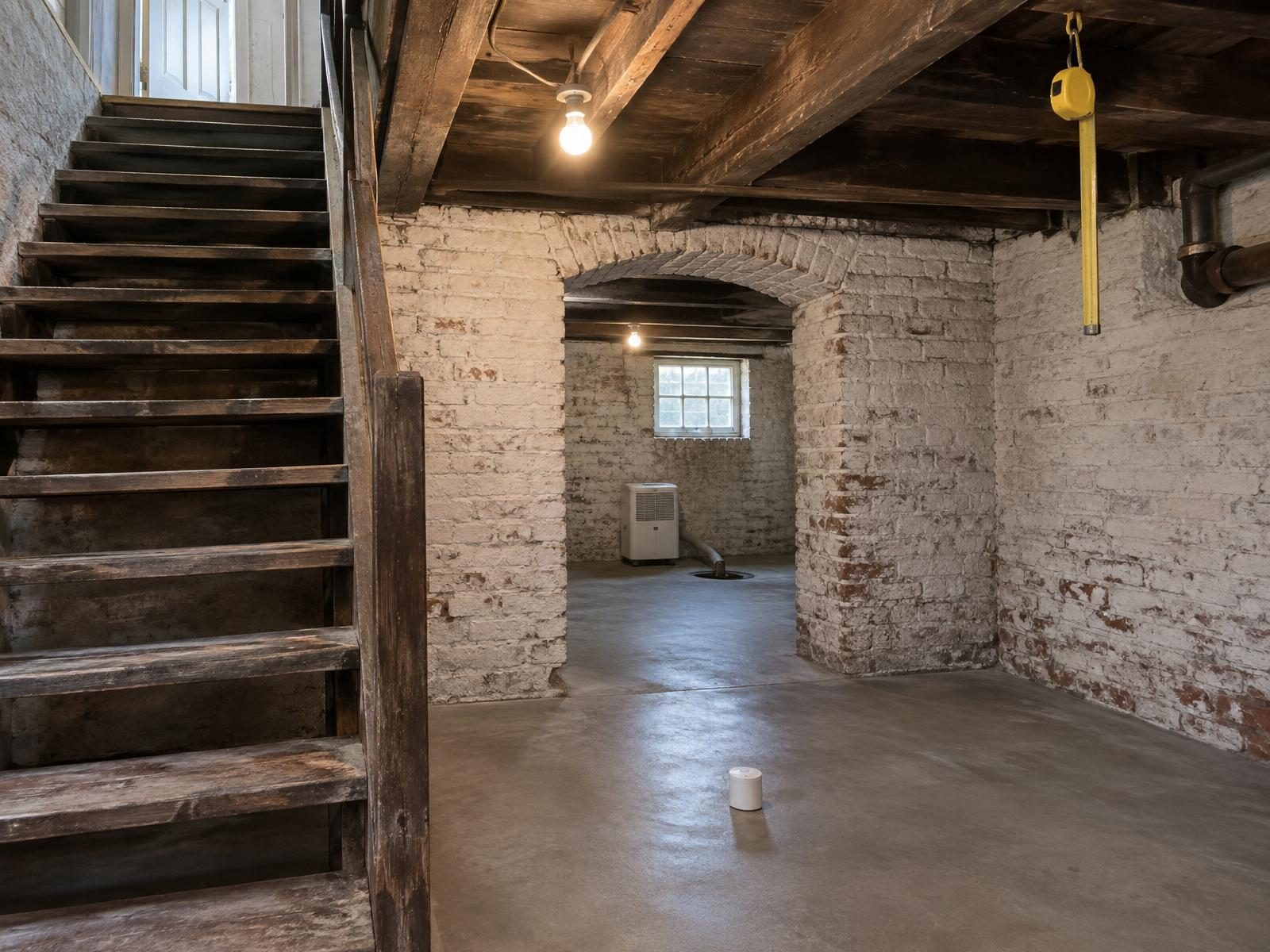
Keeping a Richmond basement dry
Before turning basement space into living space, the EPA advises checking it for leaks and other signs of moisture and fixing any moisture problem first, because damp basements promote mold and other biological growth.16 After a heavy summer storm, look for damp masonry, white mineral streaks and water at the base of the walls; those are the spots to fix before any framing goes in.
For the inside of basement walls, Building America calls for rigid foam fully adhered to the foundation with sealed seams, or spray foam, and rates closed-cell spray foam as the best moisture control of the interior options.5 The EPA warns that carpet on a basement slab can stay damp from water or vapor coming up through the concrete, or from room moisture condensing on a slab that is colder than the air, and either can lead to mold.16
What's under an older Richmond house
Basements are uncommon in new Southern houses: of those finished in 2025, 4%17 had a full or partial basement. Older Richmond houses vary widely, so start with what is actually under yours.
Beyond flooring, the EPA lists vermiculite attic and wall insulation, roofing and siding shingles, textured paint and patching compounds on walls and ceilings, and hot water and steam pipes wrapped in asbestos blanket or tape among the places asbestos may be found in a home.18 Old boiler and steam pipes in a cellar deserve a look from an accredited inspector before demolition.
Where new loads will bear on an existing foundation, Richmond asks for a sealed engineer's letter or report confirming the foundation can carry them.11 Lowering a floor to gain headroom or cutting a bigger window into old brick both touch the foundation, so expect an engineer's involvement.
Bedrooms and escape windows
The 2021 International Residential Code requires at least one operable emergency escape and rescue opening in a basement, plus one in each sleeping room, including every bedroom in a basement.19 Under that code, an escape opening needs a net clear opening of at least 5.7 square feet, at least 24 inches high and 20 inches wide, with its bottom no more than 44 inches above the floor.19 Below-grade space lit only by small, high windows can't meet that rule without a larger cut in the foundation and an area well outside, and both belong in the permit drawings.
A lower level for later years
More than one in four adults 65 and older fall each year.20 The CDC's home fall-prevention checklist recommends grab bars in and beside the tub and next to the toilet, and a non-slip surface on tub and shower floors.21 If the basement will hold a bedroom for an older relative, put the bath on the same level, add a rail on both sides of the stair and light it at the top and bottom.
What happens when you call
You call the number on this page. The call is recorded, and we connect you to one independent company that participates in our network and handles basement finishing in the Richmond area. You talk with them directly about your project, timing and price.
That company pays us for the call. You don't pay us anything, and we never call or text you. How we make money
After you're connected
Before you sign anything, look the company up yourself. Virginia's Department of Professional and Occupational Regulation advises hiring only licensed contractors, and its License Lookup shows a license's status and any past disciplinary actions.22 Check a Virginia license
Questions people ask
What does finishing a basement cost in Richmond?
We found no source that prices it for Richmond. Cost vs. Value's 2025 national figure is $52,0121 for a family room with a wet bar and a full bath; its Richmond prices for other jobs run a little under the national ones, such as a midrange bath at $25,0047 against $25,25123.
Is radon a problem in Richmond?
The Virginia Department of Health classifies Richmond City and Henrico County as moderate radon risk areas, with average indoor radon levels of 2.8 pCi/L in Richmond and 3.1 pCi/L in Henrico, below the EPA action level of 4 pCi/L, though some homes have much higher levels.13 Testing is how you learn your own house's level. Virginia residents can order a radon home test kit through the Virginia Department of Health's radon program for $3, with shipping and laboratory fees included.15
Do I need a permit to finish a basement in Richmond?
Yes, for new walls, wiring or plumbing. Richmond requires a residential building permit for new homes and for additions, alterations, repairs and renovations to existing homes, except for work the Virginia Residential Code exempts.9 In Richmond, electrical, mechanical, plumbing and gas piping work can't be included on a residential building permit; each trade needs its own permit application.10
Can a finished basement room be a bedroom?
Only with a proper way out. When an existing basement is altered, the 2021 IRC requires escape openings for any new bedrooms created there, but not for the rest of the remodeled space.19 Under that code, an escape opening needs a net clear opening of at least 5.7 square feet, at least 24 inches high and 20 inches wide, with its bottom no more than 44 inches above the floor.19 Richmond enforces Virginia's version of that code, so ask the company to confirm the numbers.
Sources
Page updated October 11, 2026. How we source our numbers
- Zonda / Journal of Light Construction, Cost vs. Value 2025, national. Released 2025. United States. Industry source.
- U.S. Census Bureau, American Community Survey 2020–2024 5-year, table B25034. Released January 29, 2026. Richmond city, Virginia, Richmond, VA metro.
- NOAA National Centers for Environmental Information, U.S. Climate Normals 1991–2020. Released 2021. Richmond International Airport (station USW00013740).
- NOAA National Centers for Environmental Information, Comparative Climatic Data, average relative humidity, period of record 1948–2018. Released November 2024. Richmond International Airport (WBAN 13740).
- U.S. Department of Energy, Building America Top Innovations: Basement Insulation Systems. No publication date. View source.
- U.S. Census Bureau, American Community Survey 2020–2024 5-year, table B25077. Released January 29, 2026. Richmond city, Virginia, Richmond, VA metro.
- Zonda / Journal of Light Construction, Cost vs. Value 2024, Richmond. Released 2024. Richmond. Industry source.
- U.S. Bureau of Labor Statistics, Occupational Employment and Wage Statistics, May 2025. Released May 15, 2026. Carpenters, Richmond, VA metro, Carpenters, United States, Electricians, Richmond, VA metro, Electricians, United States, Plumbers, Richmond, VA metro, Plumbers, United States.
- City of Richmond Department of Planning and Development Review, Homeowners Residential Building Permit Process Guide. Released February 10, 2025. View source.
- City of Richmond Department of Planning and Development Review, Residential Building Plan Review Requirements, 2021 code cycle. Released February 4, 2025. View source.
- City of Richmond Bureau of Permits and Inspections, Residential Building Plan Review Requirements (2021 code cycle). Released February 4, 2025. View source.
- Henrico County Department of Building Construction and Inspections, Permit Center: When a Building Permit is Required. No publication date. View source.
- Virginia Department of Health, Richmond and Henrico Health Districts Encourage Community Members to Test Their Homes for Radon. Released January 5, 2026. View source.
- Virginia Department of Health, EPA Radon Risk Map for Virginia. No publication date. View source.
- Virginia Department of Health, Radon Home Test Kit. No publication date. View source.
- U.S. Environmental Protection Agency, Remodeling Your Home and Indoor Air Quality. Released February 17, 2026. View source.
- U.S. Census Bureau, Characteristics of New Housing 2025: Type of Foundation in New Single-Family Houses Completed. Released 2026. South census region.
- U.S. Environmental Protection Agency, Learn About Asbestos. Released July 13, 2026. View source.
- International Code Council, 2021 International Residential Code, Chapter 3 Building Planning. Released 2021. View source. Industry source.
- Centers for Disease Control and Prevention, Facts About Older Adult Falls. Released September 4, 2026. View source.
- Centers for Disease Control and Prevention, STEADI: Check for Safety, a home fall prevention checklist for older adults. No publication date. View source.
- Virginia Department of Professional and Occupational Regulation, DPOR Consumer Guide: Hiring a Contractor. No publication date. View source.
- Zonda / Journal of Light Construction, Cost vs. Value 2024, national. Released 2024. United States. Industry source.