Whole-home remodeling in Richmond
Cost vs. Value has no whole-house price, but its 2024 Richmond page supplies the pieces: $76,6181 for a major midrange kitchen, $25,0041 for a midrange bath and $56,8511 to add a bathroom. The biggest local factor is age, since 28%2 of the city's homes went up before 1940 and a gut renovation exposes every layer of that history at once.
Calls are recorded. One independent company that handles whole-home remodels in the Richmond area answers.
Updated October 11, 2026
Pricing the rooms in a Richmond renovation
Richmond's 2024 Cost vs. Value page prices single projects, so a whole-house budget is assembled from several of them. The heat pump row applies if the plan replaces an old furnace or boiler while the walls are open.
| Measure | Richmond | U.S. average |
|---|---|---|
| Major kitchen remodel, midrange, job cost | $76,6181 | $79,9823 |
| Midrange bathroom remodel, job cost | $25,0041 | $25,2513 |
| Bathroom addition, midrange, job cost | $56,8511 | $58,5863 |
| HVAC conversion to electric heat pump, job cost | $19,4131 | $18,8003 |
Three of the four Richmond rows land under the national average, while the heat pump conversion runs slightly higher here. Total the rooms you plan to open, then carry a separate reserve for whatever turns up once the plaster comes down.
The age and shape of the housing
Census counts show how much of Richmond city predates the Second World War, and how many of its houses share a wall with the one next door.
| Measure | Richmond city | Metro |
|---|---|---|
| Homes built before 1940 | 28%2 | 9%2 |
| Homes built before 1980 | 71%2 | 44%2 |
| Single-family attached homes (rowhouses and townhouses) | 8%4 | – |
A shared party wall shapes a whole-house plan: there is little or no side yard for a new window or vent, and demolition along that wall can be felt next door. Ask how the crew will protect the neighbor's side before anything comes out.
What the house is worth before the work
A full renovation can reach a large share of what a Richmond house sells for, so the median value is a sensible check on scope.
The trades a gut job keeps busy
A whole-house job sends electricians and plumbers through every floor and keeps carpenters and cabinet installers on site from demolition to trim. BLS median hourly wages for the Richmond metro:
| Measure | Richmond metro | United States |
|---|---|---|
| Electricians, median hourly wage | $29.50/hr6 | $30.38/hr6 |
| Plumbers, median hourly wage | $29.56/hr6 | $30.67/hr6 |
| Carpenters, median hourly wage | $24.94/hr6 | $29.12/hr6 |
| Cabinetmakers and bench carpenters, median hourly wage | $22.71/hr6 | $22.44/hr6 |
Carpenters show the widest gap below the national median of these trades, so renovations heavy on framing, stair repair and trim feel Richmond's lower labor costs most.
Permits
These rules cover houses inside the Richmond city line; Henrico and Chesterfield counties run their own permit offices. A whole-house job nearly always crosses into permit territory, because rewiring, moving plumbing or taking out a wall falls outside the exemptions for finishes. Each trade files separately, the city wants alteration plans that show what comes out and what goes in, and in an Old and Historic District the exterior pieces go to the Commission of Architectural Review first. A permit lapses if inspections stop, so a long, phased job needs inspections spread through it.
- Richmond requires a residential building permit for new homes and for additions, alterations, repairs and renovations to existing homes, except for work the Virginia Residential Code exempts.7
- In Richmond, electrical, mechanical, plumbing and gas piping work can't be included on a residential building permit; each trade needs its own permit application.8
- For alterations, Richmond wants floor plans of each level the work touches that tell existing, new and demolished walls apart and show bedroom window sizes and sill heights, ceiling heights in altered rooms and rooms with a new use, and the insulation R-value of wall, floor and rafter cavities opened during the renovation.9
- A Richmond building permit may be routed to several reviewers at once, including zoning, Planning and Preservation, the Commission of Architectural Review, Public Utilities and the Fire Department, and the initial review is completed within 10 business days of the application reaching plan review.9
- In Richmond, the electrical, plumbing and mechanical rough-in inspections must be approved before a framing inspection can be requested.9
- In one of Richmond's Old and Historic Districts, exterior alterations visible from the public right of way need a certificate of appropriateness from the Commission of Architectural Review before a building permit is issued, and work that is normally exempt from a building permit may still need one.9
- A Richmond building permit is valid for 180 days from issuance, and each building inspection extends it another 180 days from the date of that inspection.9
Checked October 11, 2026
Talk to a pro who handles whole-home remodels in Richmond
Calls are recorded. You'll be connected to one independent company that handles whole-home remodels in your area. We never call or text you. Privacy Policy ·Do Not Sell or Share My Personal Information
Opening up a prewar Richmond house
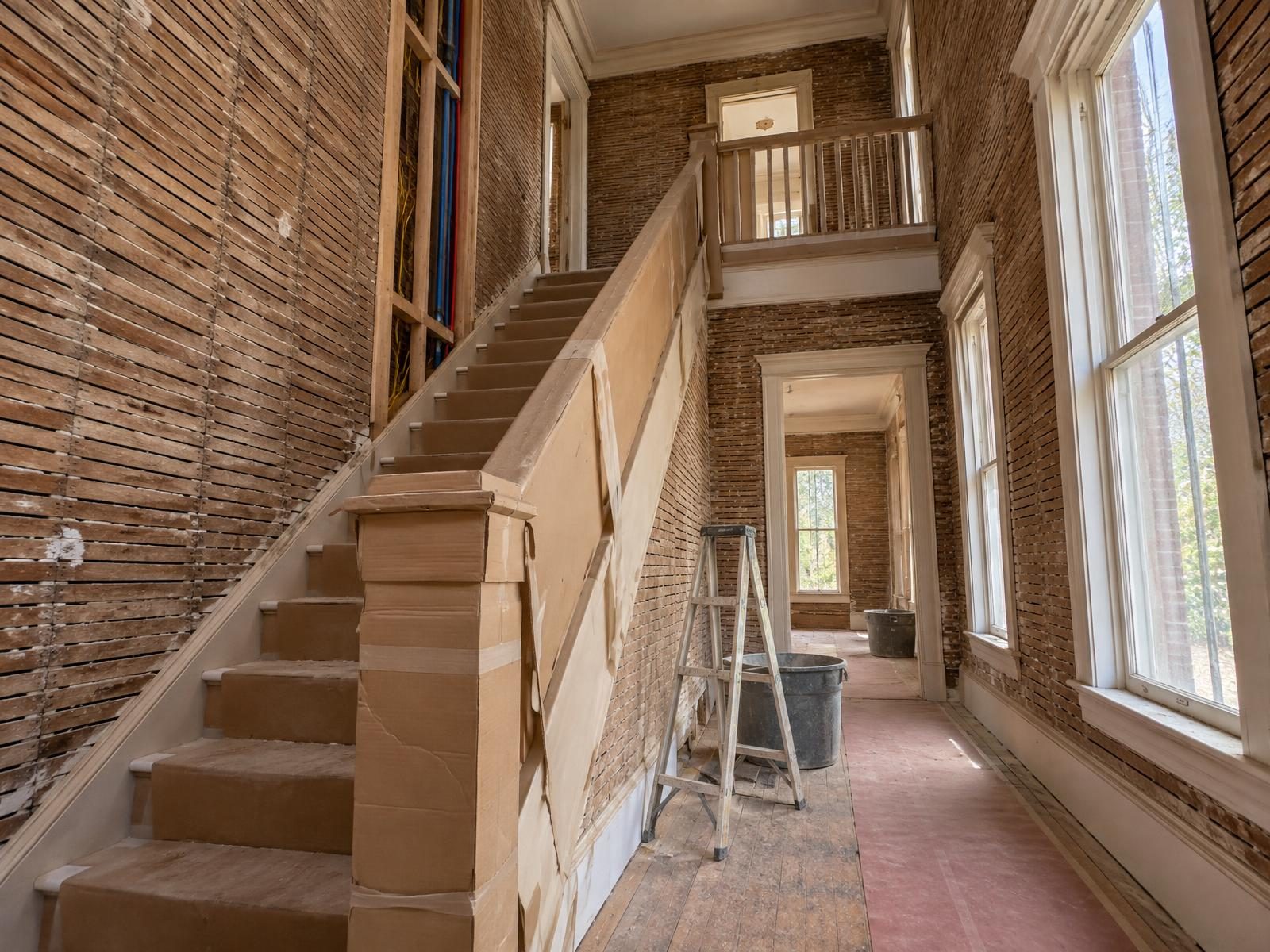
Whole-house projects in the city tend to land in houses that have already been through generations of piecemeal updates. Richmond's Fan Area Historic District, nearly a hundred city blocks of turn-of-the-20th-century town houses with more than two thousand buildings, is listed on the Virginia Landmarks Register and the National Register.10 Behind the plaster in a house like that you can find wiring, gas piping and drains from several different eras, and the plan has to decide which of them stay.
Unless a lead-based paint inspection shows otherwise, the EPA says to treat paint in homes built before 1978 as if it contains lead.11 EPA's lead renovation rule requires anyone paid to disturb painted surfaces in a home built before 1978 to be lead-safe certified, and the EPA says about three-quarters of U.S. homes built before 1978 still contain some lead-based paint.12 When demolition moves from room to room for weeks, lead-safe dust control becomes a daily routine on the job rather than a single step.
Where new loads will bear on an existing foundation, Richmond asks for a sealed engineer's letter or report confirming the foundation can carry them.9 That comes up when a renovation adds an upstairs bathroom, a heavy tile floor, or a beam where a bearing wall used to stand. Richmond does not require residential plans to be prepared by a registered design professional; the applicant, owner or contractor may draw them, but structural elements that fall outside the Virginia Residential Code's limits need sealed engineering documents.9
The National Park Service recommends running new pipes, ducts and wiring as inconspicuously as possible, through secondary spaces, closets, the attic or the basement, so character-defining rooms and finishes aren't destroyed.13 In a rowhouse that keeps its mantels and stair, ask where the new risers and duct runs will go before the drawings are final.
Historic review and tax credits
Richmond's Commission of Architectural Review, set up by City Council in 1957, reviews all exterior changes to structures in the city's Old and Historic Districts and bases its decisions on the Secretary of the Interior's Standards and the city's Old and Historic Districts design guidelines.14 Richmond's City Old and Historic Districts include Church Hill North, Union Hill, Jackson Ward, Monument Avenue, West Franklin Street, West Grace Street and Shockoe Valley, among others.14 The commission looks at exterior changes, and a whole-house job often reaches the outside: new windows, a rear addition, a moved door or a condenser in view of the street.
The Commission of Architectural Review's secretary can approve some projects on staff review, such as painting, replacement doors and porch decking, new handrails and porch rails, porch roof replacements and exterior storm windows and doors, and applications approved by staff carry no fee.14 The Commission of Architectural Review meets on the fourth Tuesday of each month, the third in December, and applications are due weeks ahead; for its November 24, 2026 meeting the deadline is October 30.14 Simple items may clear on staff review, while anything that needs the full commission belongs at the front of the schedule.
Virginia's state historic rehabilitation tax credit, open to owner-occupied homes, equals 25% of eligible rehabilitation expenses for a certified historic structure, such as a contributing building in a listed historic district, if the whole project meets the Secretary of the Interior's Standards.15 Virginia's Department of Historic Resources lists new plumbing systems and updating kitchens and bathrooms among eligible expenses, while appliances and additions are not.15
For an owner-occupied home, Virginia's state historic tax credit counts only if eligible rehabilitation spending reaches at least 25% of the building's assessed value within a consecutive 24-month period, or 60 months for a phased project.15 Virginia's historic tax credit runs on a three-part application, with Part 1 certifying the building as historic, Part 2 reviewing the proposed work and Part 3 reviewing the finished work; the state program's application deadline is one year after the project's completion date.15 A gut renovation of a contributing house can clear that spending bar by itself, so confirm the listing and contact the department before demolition, while the review of proposed work can still shape the plan.
Living in a narrow house during the work
In a city house with one stair, the crew and the family share the only route to the upper floors, which makes a clean line between work zone and living space hard to hold. For very dusty work such as demolition, the EPA describes isolating the work area: sealing it off with no direct access to the occupied rooms, with workers using a separate entrance until cleanup is done.11 For the demolition stretch, that often means staying somewhere else for a while.
Once permits are open, the inspector looks past the rooms you renovated. When alterations, repairs or additions that need a permit are made, the 2021 International Residential Code requires the home to have smoke alarms where a new house would, including in each bedroom, outside each sleeping area and on every story; exterior-only work and plumbing or mechanical work are exempt.16 At the final inspection, Richmond's building inspector checks smoke detectors, handrails, guardrails, required egress and access to the attic and concealed spaces.9
Building in aging-in-place while the walls are open
More than one in four adults 65 and older fall each year.17 A whole-house renovation is an easier time than any other to add blocking for future grab bars, widen a doorway or put a full bath on the first floor, because the walls are already open. NAHB's Certified Aging-in-Place Specialist (CAPS) credential trains remodelers in home modifications for aging in place.18
What happens when you call
You call the number on this page. The call is recorded, and we connect you to one independent company that participates in our network and handles whole-home remodels in the Richmond area. You talk with them directly about your project, timing and price.
That company pays us for the call. You don't pay us anything, and we never call or text you. How we make money
After you're connected
Before you sign anything, look the company up yourself. Virginia's Department of Professional and Occupational Regulation advises hiring only licensed contractors, and its License Lookup shows a license's status and any past disciplinary actions.19 Check a Virginia license
Questions people ask
What does a whole-house remodel cost in Richmond?
There is no single published figure. Richmond's 2024 Cost vs. Value page puts a major midrange kitchen at $76,6181, a midrange bath at $25,0041 and a heat pump conversion at $19,4131; total the rooms in your plan and hold a reserve for what the walls hide.
Do I need permits for a whole-house renovation in Richmond?
Almost certainly, once walls, wiring or plumbing change. Richmond requires a residential building permit for new homes and for additions, alterations, repairs and renovations to existing homes, except for work the Virginia Residential Code exempts.7 In Richmond, electrical, mechanical, plumbing and gas piping work can't be included on a residential building permit; each trade needs its own permit application.8
My house is in a historic district. What changes?
In one of Richmond's Old and Historic Districts, exterior alterations visible from the public right of way need a certificate of appropriateness from the Commission of Architectural Review before a building permit is issued, and work that is normally exempt from a building permit may still need one.9 New windows, doors, rear additions and equipment you can see from the street are the kinds of changes that review covers.
Can a historic tax credit help pay for the work?
Possibly, if the house is a certified historic structure. Virginia's state historic rehabilitation tax credit, open to owner-occupied homes, equals 25% of eligible rehabilitation expenses for a certified historic structure, such as a contributing building in a listed historic district, if the whole project meets the Secretary of the Interior's Standards.15 For an owner-occupied home, Virginia's state historic tax credit counts only if eligible rehabilitation spending reaches at least 25% of the building's assessed value within a consecutive 24-month period, or 60 months for a phased project.15
Sources
Page updated October 11, 2026. How we source our numbers
- Zonda / Journal of Light Construction, Cost vs. Value 2024, Richmond. Released 2024. Richmond. Industry source.
- U.S. Census Bureau, American Community Survey 2020–2024 5-year, table B25034. Released January 29, 2026. Richmond city, Virginia, Richmond, VA metro.
- Zonda / Journal of Light Construction, Cost vs. Value 2024, national. Released 2024. Major kitchen remodel, United States, HVAC conversion to electric heat pump, United States. Industry source.
- U.S. Census Bureau, American Community Survey 2020–2024 5-year, table B25024. Released January 29, 2026. Richmond city, Virginia.
- U.S. Census Bureau, American Community Survey 2020–2024 5-year, table B25077. Released January 29, 2026. Richmond city, Virginia, Richmond, VA metro.
- U.S. Bureau of Labor Statistics, Occupational Employment and Wage Statistics, May 2025. Released May 15, 2026. Electricians, Richmond, VA metro, Electricians, United States, Plumbers, Richmond, VA metro, Plumbers, United States, Carpenters, Richmond, VA metro, Carpenters, United States, Cabinetmakers and bench carpenters, Richmond, VA metro, Cabinetmakers and bench carpenters, United States.
- City of Richmond Department of Planning and Development Review, Homeowners Residential Building Permit Process Guide. Released February 10, 2025. View source.
- City of Richmond Department of Planning and Development Review, Residential Building Plan Review Requirements, 2021 code cycle. Released February 4, 2025. View source.
- City of Richmond Bureau of Permits and Inspections, Residential Building Plan Review Requirements (2021 code cycle). Released February 4, 2025. View source.
- Virginia Department of Historic Resources, Fan Area Historic District (127-0248). Released June 22, 2026. View source.
- U.S. Environmental Protection Agency, Best Practices for Indoor Air Quality when Remodeling Your Home. Released June 23, 2026. View source.
- U.S. Environmental Protection Agency, Lead Renovation, Repair and Painting Program. Released June 17, 2026. View source.
- National Park Service, Technical Preservation Services, Preservation Brief 18: Rehabilitating Interiors in Historic Buildings. Released 1988. View source.
- City of Richmond Commission of Architectural Review, Commission of Architectural Review. No publication date. View source.
- Virginia Department of Historic Resources, Historic Rehabilitation Tax Credits. No publication date. View source.
- International Code Council, 2021 International Residential Code, Chapter 3 Building Planning. Released 2021. View source. Industry source.
- Centers for Disease Control and Prevention, Facts About Older Adult Falls. Released September 4, 2026. View source.
- National Association of Home Builders, Certified Aging-in-Place Specialist (CAPS). No publication date. View source. Industry source.
- Virginia Department of Professional and Occupational Regulation, DPOR Consumer Guide: Hiring a Contractor. No publication date. View source.