Accessible bathrooms in Baltimore
A universal-design bathroom cost $41,2961 in Baltimore in the 2024 Cost vs. Value report, close to the $40,7502 national figure. The bigger local factor is who lives in the houses: 31%34 of owner-occupied homes in Baltimore city are headed by someone sixty-five or older, and 41%5 of the city's homes were built before 1940, long before anyone laid out a bathroom around a walker or a shower seat.
Calls are recorded. One independent company that handles accessible bathrooms in the Baltimore area answers.
Updated October 11, 2026
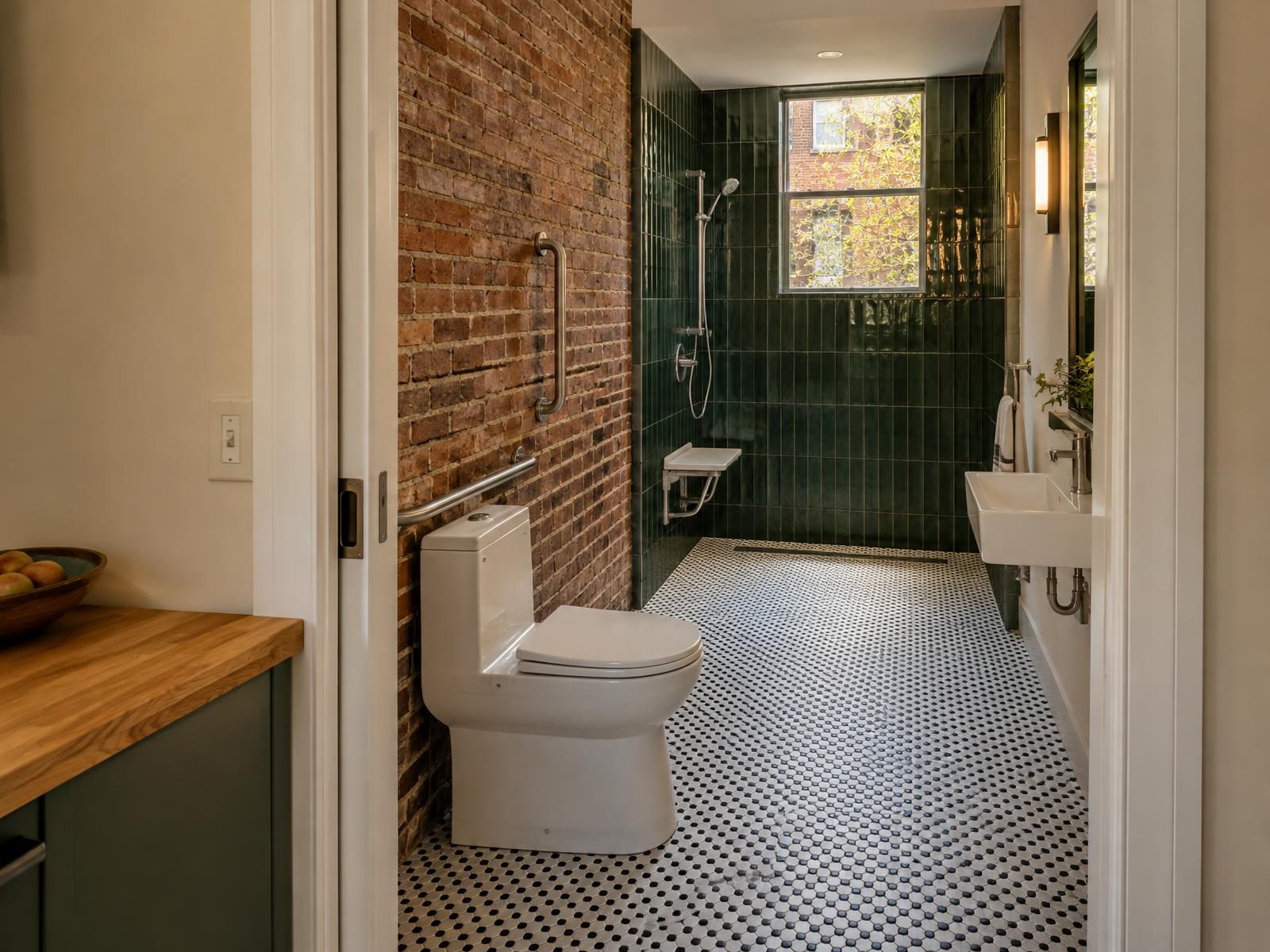
What an accessible bath costs here
Cost vs. Value prices a universal-design bath, with the tub swapped for a curbless shower and a wider door, next to its ordinary midrange bath. Baltimore's newest page is in the 2024 edition.
| Measure | Baltimore | U.S. average |
|---|---|---|
| Universal-design bathroom remodel, job cost | $41,2961 | $40,7502 |
| Midrange bathroom remodel, job cost | $25,7941 | $25,2512 |
The gap between the two Baltimore rows is the price of the accessible features themselves: a floor that drains without a curb, a wider opening, controls within reach of someone seated. Ask each company to price those items on their own lines so you can compare quotes.
How many households here are aging in place
The Census Bureau counts homes by the age of the person who heads the household. These shares come from its count for the city and the wider metro.
| Measure | Baltimore city | Metro |
|---|---|---|
| Owner-occupied homes headed by someone 65 or older | 31%34 | 31%34 |
| Owner-occupied homes headed by someone 75 or older | 12%34 | 12%34 |
| All occupied homes headed by someone 65 or older | 25%34 | 27%34 |
Older owners are about as common inside the city line as in the counties around it, so planning a bathroom that still works late in life is a question for rowhouse blocks and suburban ramblers alike.
Income limits for city repair help
Baltimore City's housing department posts the household income ceilings for its home repair loans and grants, which include grants for making a home accessible to someone with a disability.
| Measure | Baltimore City |
|---|---|
| Income limit for city home repair help, one-person household | $74,8006 |
| Income limit for city home repair help, two-person household | $85,4506 |
Civic Works, one of the partners in Baltimore's Housing Upgrades to Benefit Seniors (HUBS) program, says HUBS is working through a long waitlist and isn't enrolling new applicants, and lists grab bars at the tub or shower and handrails among the safety repairs on the city's repair waitlist.7 Ask the city how long the wait is before you build a schedule around its money.
How old the bathrooms are likely to be
Census counts of homes by the decade they were built show how much of Baltimore predates modern bathroom layouts.
What the trades on this job earn here
An accessible bath leans on a plumber to move the drain for a curbless floor, a carpenter for blocking and a wider door, an electrician for lighting and switches at seated height, and a tile setter. Median hourly wages:
| Measure | Baltimore metro | United States |
|---|---|---|
| Plumbers, median hourly wage | $30.38/hr8 | $30.67/hr8 |
| Carpenters, median hourly wage | $29.99/hr8 | $29.12/hr8 |
| Electricians, median hourly wage | $31.54/hr8 | $30.38/hr8 |
| Tile and stone setters, median hourly wage | No published estimate8 | $26.77/hr8 |
BLS publishes no tile-setter median for this metro. The other trades sit near their national medians, which fits a local universal-design price that tracks the national one.
Permits
Grab bars and new tile on their own are light work, but an accessible bath usually goes further: dropping the shower floor and moving the drain is plumbing, a new light or switch height is electrical, and widening a door in a bearing wall is structural. Which office reviews it depends on whether the house sits in Baltimore City or Baltimore County, and a ramp or new door on the outside of a city house in a historic district also goes to preservation review. Neither office posts fees or review times on these pages.
- The city's building code exempts interior painting, papering, tiling, carpeting, cabinets, countertops and similar finish work from a building permit.9
- Changing, installing or replacing plumbing, electrical, gas or mechanical systems needs a permit and a licensed contractor; for one- and two-family homes the contractor also needs a Maryland Home Improvement Commission license.10
- In a Baltimore City local historic district, CHAP reviews all exterior changes to buildings, and work not visible from the street still needs an Authorization to Proceed.11
- Baltimore County requires a permit for any addition, alteration or structural modification to an existing home, including creating a new bedroom or kitchen.12
- In Baltimore County all electrical and plumbing work requires a permit, pulled by a licensed electrician or plumber, and a private contractor doing residential work must give its Maryland Home Improvement License number.12
Checked October 11, 2026
Talk to a pro who handles accessible bathrooms in Baltimore
Calls are recorded. You'll be connected to one independent company that handles accessible bathrooms in your area. We never call or text you. Privacy Policy ·Do Not Sell or Share My Personal Information
Fitting an accessible bath into a Baltimore house
50%13 of homes in Baltimore city are one-unit attached houses, the Census group that takes in rowhouses. If your only full bathroom is upstairs, as it is in many two-story rowhouses, the stairs can be as much of a problem as the tub.
That leaves two common plans. One rebuilds the upstairs bath with a curbless shower and leaves the stairs to a rail or a lift; the other puts a new bathroom on the first floor, often at the back of the house near the kitchen plumbing. A first-floor bath is a bigger job with its own drain run, so ask for both options priced before you choose.
Across the metro, 22%5 of homes went up between 1950 and 1969. Bathrooms from those decades tend to be compact, with a tub set between two walls, and the fix there is usually the doorway and the tub rather than the floor plan.
Who it helps and what to plan around
More than one in four adults 65 and older fall each year.14 The CDC says falling once doubles an older adult's chances of falling again.14 In a bathroom, the hard, wet floor is where those odds play out.
The CDC's home fall-prevention checklist recommends grab bars in and beside the tub and next to the toilet, and a non-slip surface on tub and shower floors.15 The National Institute on Aging suggests non-skid surfaces wherever a floor can get wet and a light left on in the bathroom at night.16 Even if nobody in the house needs bars today, have backing set in the walls while they are open.
If you have fallen, the NIA notes, your doctor might suggest that an occupational therapist, physical therapist or nurse visit your home to assess its safety and advise you about changes.16 Notes from that visit on how the person moves and which side they transfer from give a Baltimore company a much clearer brief than a list of products. NAHB's Certified Aging-in-Place Specialist (CAPS) credential trains remodelers in home modifications for aging in place.17
Help paying for it in Baltimore and Maryland
Baltimore City's housing department offers home repair loans, some of which may be forgiven or deferred, and grants for work such as making a home more accessible for people with disabilities, but only for owner-occupied homes whose owners meet its income limits.6 The city's income limits for a one- or two-person household are in the table above; larger households have higher limits on the city's page.
The state has its own program aimed squarely at this kind of work. Maryland's Accessible Homes for Seniors program helps owner-occupants when at least one resident is 55 or older and household income is no more than 80 percent of the statewide or Washington, DC metro median, paying for changes such as wider doorways, accessible showers, ramps, grab bars and lever handles, and it considers adding a first-floor bathroom case by case.18 Its loans carry zero percent interest and are deferred for 30 years, coming due when the home is sold, transferred or refinanced, and grants of up to $25,000 go to senior homeowners who don't qualify for a loan.18
Veterans can also ask the VA. The VA's Home Improvements and Structural Alterations (HISA) benefit pays for medically necessary changes to a veteran's or servicemember's primary residence, including use of essential bathroom facilities such as roll-in showers and lowering sinks and counters.19 Programs open and close and money runs out, so get the terms in writing before you sign a contract that depends on them.
What happens when you call
You call the number on this page. The call is recorded, and it goes to one independent company that handles accessible bathroom remodels in the Baltimore area. You talk with them directly about who will use the room, what has to change and what it will cost.
We are paid for the call. You don't pay us anything, and we never call or text you. How we make money
After you're connected
Look the company up yourself before you sign or pay a deposit. Maryland's Home Improvement Commission licenses home improvement contractors and salespersons, and its License Search shows whether a license is current.20 Check a Maryland license
Questions people ask
How much does an accessible bathroom cost in Baltimore?
The 2024 Cost vs. Value report put a universal-design bathroom in Baltimore at $41,2961, against $25,7941 for a standard midrange bath. A first-floor bathroom added to a rowhouse is a different and larger job, so ask for it to be priced separately.
Is there help paying for an accessible bathroom in Baltimore?
Possibly, from more than one place. Baltimore City's housing department offers home repair loans, some of which may be forgiven or deferred, and grants for work such as making a home more accessible for people with disabilities, but only for owner-occupied homes whose owners meet its income limits.6 Maryland's Accessible Homes for Seniors program helps owner-occupants when at least one resident is 55 or older and household income is no more than 80 percent of the statewide or Washington, DC metro median, paying for changes such as wider doorways, accessible showers, ramps, grab bars and lever handles, and it considers adding a first-floor bathroom case by case.18 Waitlists can be long, so ask each program about timing.
Do I need a permit to make my bathroom accessible?
Usually, once the work goes past finishes. Changing, installing or replacing plumbing, electrical, gas or mechanical systems needs a permit and a licensed contractor; for one- and two-family homes the contractor also needs a Maryland Home Improvement Commission license.10 In Baltimore County all electrical and plumbing work requires a permit, pulled by a licensed electrician or plumber, and a private contractor doing residential work must give its Maryland Home Improvement License number.12
Who will I talk to when I call?
One independent company that handles accessible bathroom remodels in the Baltimore area. We don't do the work ourselves, and you can check the company's license before you agree to anything. Maryland's Home Improvement Commission licenses home improvement contractors and salespersons, and its License Search shows whether a license is current.20
Sources
Page updated October 11, 2026. How we source our numbers
- Zonda / Journal of Light Construction, Cost vs. Value 2024, Baltimore. Released 2024. Baltimore. Industry source.
- Zonda / Journal of Light Construction, Cost vs. Value 2024, national. Released 2024. United States. Industry source.
- U.S. Census Bureau, American Community Survey 2020–2024 5-year, table B25007. Released January 29, 2026. Baltimore city.
- U.S. Census Bureau, American Community Survey 2020–2024 5-year, table B25003. Released January 29, 2026. Baltimore city.
- U.S. Census Bureau, American Community Survey 2020–2024 5-year, table B25034. Released January 29, 2026. Baltimore city, Baltimore-Columbia-Towson metro.
- Baltimore City Department of Housing & Community Development, Get Help With Your Home Repairs. No publication date. Baltimore City.
- Civic Works, Apply for Home Repair and Energy Services. Released May 21, 2026. View source. Industry source.
- U.S. Bureau of Labor Statistics, Occupational Employment and Wage Statistics, May 2025. Released May 15, 2026. Plumbers, Baltimore-Columbia-Towson metro, Plumbers, United States, Carpenters, Baltimore-Columbia-Towson metro, Carpenters, United States, Electricians, Baltimore-Columbia-Towson metro, Electricians, United States, Tile and stone setters, Baltimore-Columbia-Towson metro, Tile and stone setters, United States.
- Baltimore City Building, Fire and Related Codes, Section 105.2, Work exempt from permit. No publication date. View source.
- Baltimore City Department of Housing & Community Development, Building Permits. No publication date. View source.
- Baltimore City Commission for Historical and Architectural Preservation, Local Historic District Designation. Released August 5, 2025. View source.
- Baltimore County Department of Permits, Approvals and Inspections, Addition, alteration or modification permits. No publication date. View source.
- U.S. Census Bureau, American Community Survey 2020–2024 5-year, table B25024. Released January 29, 2026. Baltimore city.
- Centers for Disease Control and Prevention, Facts About Older Adult Falls. Released September 4, 2026. View source.
- Centers for Disease Control and Prevention, STEADI: Check for Safety, a home fall prevention checklist for older adults. No publication date. View source.
- National Institute on Aging, Preventing Falls at Home: Room by Room. Released September 12, 2022. View source.
- National Association of Home Builders, Certified Aging-in-Place Specialist (CAPS). No publication date. View source. Industry source.
- Maryland Department of Housing and Community Development, Accessible Homes for Seniors. No publication date. View source.
- U.S. Department of Veterans Affairs, Home Improvements and Structural Alterations (HISA). Released February 12, 2025. View source.
- Maryland Department of Labor, Maryland Home Improvement Commission. No publication date. View source.