Rental conversions
The one national price we found for this kind of project is $166,4061 for a new detached ADU in the 2025 Cost vs. Value report; we found no credible national figure for converting a basement, attic or garage you already have. Whether a conversion works depends first on local zoning, parking and owner-occupancy rules, then on the fire and exit rules that let two households live safely under one roof.
Updated October 11, 2026
Choose your area
Local guides will cover each metro's accessory unit rules, the age of its houses and the permit office that reviews conversions. These metros come first.
The national numbers, and what they leave out
We found no credible national price for converting space inside an existing house, so this table pairs the one accessory unit Cost vs. Value prices with early results from a HUD-funded review of 3142 local ADU ordinances in small and mid-sized cities. Cost vs. Value's ADU job is a new one-story, 660-square-foot detached unit on a slab, with a bedroom suite, a bath with walk-in shower, a kitchen, a mini-split heat pump, a stacked washer and dryer, and a paved parking space.3
| Measure | United States |
|---|---|
| Accessory dwelling unit (new detached build), job cost | $166,4061 |
| Accessory dwelling unit (new detached build), resale value | $68,6561 |
| Reviewed local ADU ordinances that require the main house to be owner-occupied, share | 60%2 |
| Reviewed local ADU ordinances that require parking spaces, share | 54%2 |
| Reviewed local ADU ordinances that require a special permit or process, share | 61%2 |
| Reviewed local ADU ordinances that regulate how ADUs look, share | 65%2 |
A conversion reuses a foundation, roof and outside walls that a new cottage has to pay for, but it takes on whatever conditions the local ordinance attaches to the lot. In the ordinances the study reviewed, owner occupancy, parking and special permits were each required more often than not.
What counts as an accessory unit
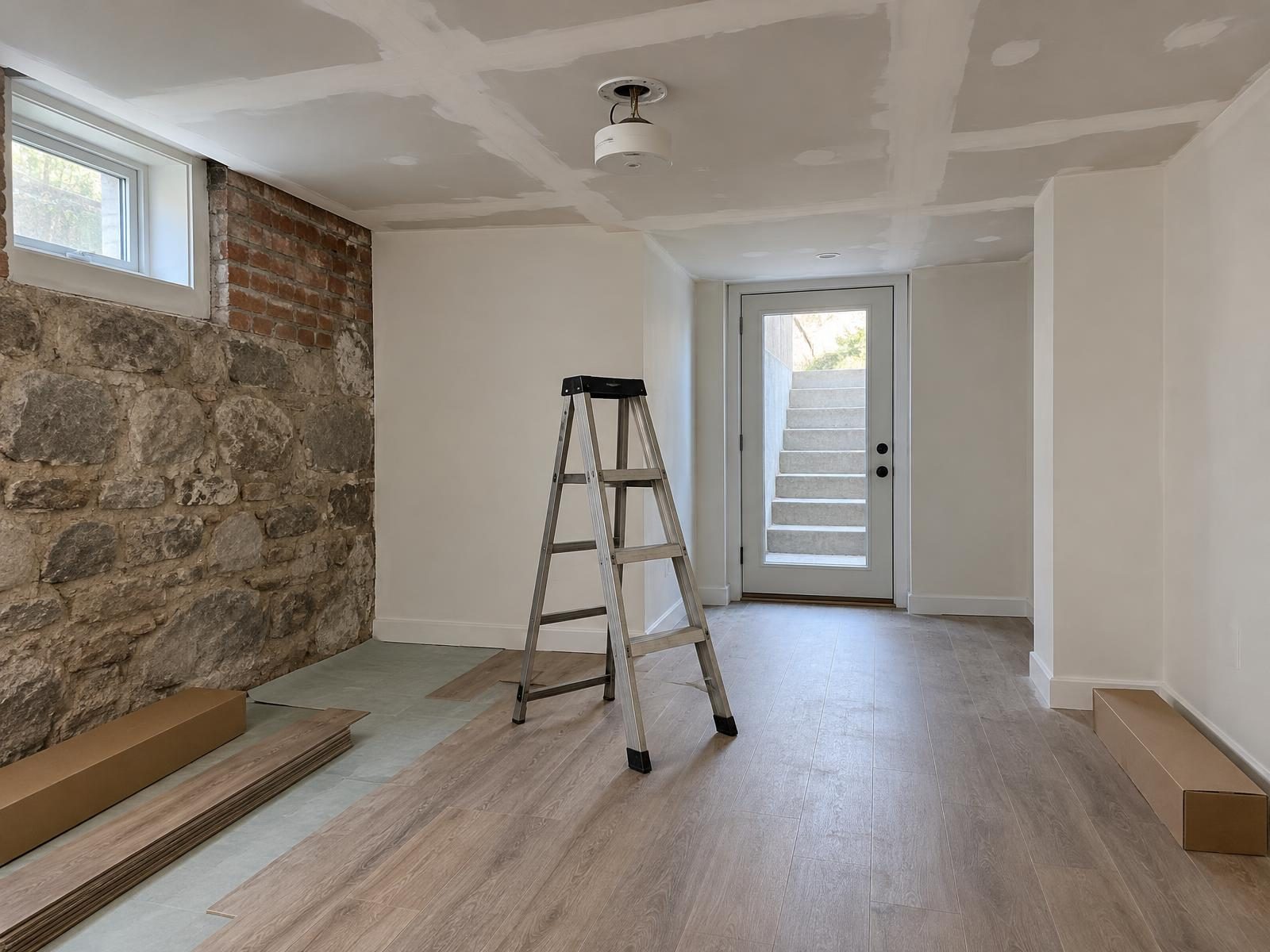
HUD's research office describes an ADU as compact, self-contained secondary housing on the same lot as an existing single-family home.2 Maryland's Department of Planning describes ADUs as converted rooms inside an existing house, additions, or new or converted stand-alone accessory structures.4 A basement apartment, a unit over the garage and a converted attic all fit that description. Turning one house into two separate homes is a duplex conversion; it raises the same safety questions below, and the zoning answer may be different.
Whether you can rent out any of it is decided locally, by the zoning code of your county, city or town, and those codes attach very different conditions. States have started to step in. Maryland's HB 1466, passed in 2025, requires every county and municipality with planning and zoning authority to adopt a local law allowing ADUs on lots with a single-family detached house by October 1, 2026.4
A Virginia law enacted in 2026 and taking effect July 1, 2027 makes ADUs a permitted accessory use in single-family zoning districts, though it does not apply to localities that adopted an ADU ordinance before January 1, 2026.5 Until a state rule reaches your lot, the local code is the one that counts.
Fire separation and a way out for each unit
When part of a house becomes its own dwelling unit, the walls and floor between the two homes stop being ordinary partitions. The International Residential Code covers detached one- and two-family dwellings and townhouses no more than three stories above grade, each with a separate means of egress.6 The 2021 IRC requires the units of a two-family dwelling to be separated by walls and floors with at least a 1-hour fire-resistance rating, or a 1/2-hour rating if the building has an automatic sprinkler system throughout.7 A building with three or more units falls outside that scope, so a different code applies; ask your building department which one.
The 2021 IRC requires at least one egress door for each dwelling unit, reached by a continuous path that does not pass through a garage, and opening to a public way or a yard or court that leads to one.7 For a basement or attic unit, decide where its door and its path to the street will go before anything else is drawn.
The 2021 IRC requires at least 5/8-inch Type X gypsum board or equivalent between a garage and habitable rooms above it, and does not allow any opening from a garage directly into a sleeping room.7 Maryland requires residential fire sprinkler systems in all new one- and two-family dwellings, which the state's planning department says includes newly built ADUs.8 Sprinklers can change the separation a building needs, so ask the company and the building department how they apply to your plan.
Parking, zoning and owner-occupancy rules
These are set where you live, and they change. In the HUD-funded review, 60%2 of local ordinances required the main house to be owner-occupied and 54%2 required parking spaces for the unit.
Some states now limit what towns can demand. Under Maryland's ADU law, a local government can't add parking requirements for ADUs without first completing a parking study, and any parking requirement it adopts must include a waiver process.8 Under that law, a Virginia locality may require the owner to live in either the ADU or the main house, but only at the time the application to build or convert the unit is filed.5 Virginia localities may also require dedicated parking for the ADU, replacement of any required parking the ADU eliminates, and rental leases of 30 consecutive days or longer.5
Counties and cities still write the details. Montgomery County, Maryland, requires a building permit for every ADU, and the main house or the accessory apartment must be the applicant's primary residence to get a rental license.9 Before you pay for drawings, read your county or city's accessory dwelling or accessory apartment guide, or call its zoning office, and ask about parking, owner occupancy, size limits, where the entrance can go, rental licensing and short-term rentals.
Expect an inspector to sign off before anyone moves in. Under the 2021 IRC, a building or part of a building can't be occupied, or changed to a new occupancy, until the building official issues a certificate of occupancy.6
Smoke and carbon monoxide alarms
The 2021 IRC requires smoke alarms in each sleeping room, outside each separate sleeping area and on every story including basements, interconnected within each dwelling unit so that one sounding sets off all of them.7 For new construction, it requires carbon monoxide alarms outside each separate sleeping area of a dwelling unit that has a fuel-fired appliance or an attached garage that opens into it.7
When work that needs a permit is done, the 2021 IRC requires each dwelling unit to get carbon monoxide alarms as required for new homes, with exceptions for exterior work and plumbing.7 The Consumer Product Safety Commission says more than 200 people in the U.S. die every year from accidental non-fire carbon monoxide poisoning linked to consumer products, and recommends CO alarms on every level and outside sleeping areas.10
The U.S. Fire Administration says homeowners and landlords should put smoke alarms in every bedroom, outside each sleeping area and on every level, test them monthly, and replace them 10 years from their manufacture date.11 Ask whether the new unit's alarms will be hard-wired and linked to each other, and put the test dates on the same calendar as the lease renewals.
Lead-safe work in houses built before 1978
EPA's lead renovation rule requires anyone paid to disturb painted surfaces in a home built before 1978 to be lead-safe certified, and the EPA says about three-quarters of U.S. homes built before 1978 still contain some lead-based paint.12 EPA's lead renovation rule generally doesn't cover homeowners working on their own pre-1978 homes, but it does apply if you rent out all or part of your home.12
A landlord who does renovation work on pre-1978 rental housing personally needs both EPA firm and renovator certification; a landlord who hires the work out needs neither, but the firm must be Lead-Safe Certified.13 Federal law requires renovation firms working in a rented home to give the renters EPA's Renovate Right pamphlet no more than 60 days before work begins.14
Before a renter signs a lease for most pre-1978 housing, federal law requires the landlord to disclose known lead-based paint and hazards, share available records, hand over EPA's Protect Your Family From Lead pamphlet and include a Lead Warning Statement.15 Keep the renovation firm's lead-safe paperwork with the permits; it is part of the record you may be asked to share.
Talk over a rental unit with a local company
Calls are recorded. You'll be connected to one independent company that handles rental conversion remodels in your area. We never call or text you. Privacy Policy ·Do Not Sell or Share My Personal Information
Sources
Page updated October 11, 2026. How we source our numbers
- Zonda / Journal of Light Construction, Cost vs. Value 2025, national. Released 2025. United States. Industry source.
- U.S. Department of Housing and Urban Development, PD&R, PD&R Edge: Evaluating Accessory Dwelling Units in Small- to Medium-Sized Cities. Released January 8, 2026. United States (cities under 500,000 people).
- Zonda / Journal of Light Construction, Cost vs. Value project description: Accessory Dwelling Unit. Released September 23, 2025. View source. Industry source.
- Maryland Department of Planning, Accessory Dwelling Units. No publication date. View source.
- Virginia General Assembly (Virginia Law Library), Code of Virginia § 15.2-2292.4, Development and use of accessory dwelling units. Released 2026. View source.
- International Code Council, 2021 International Residential Code, Chapter 1 Scope and Administration. Released 2021. View source. Industry source.
- International Code Council, 2021 International Residential Code, Chapter 3 Building Planning. Released 2021. View source. Industry source.
- Maryland Department of Planning, ADU Bill (HB 1466) FAQ for Local Governments. No publication date. View source.
- Montgomery County, Maryland, Department of Permitting Services, Zoning and Permitting Requirements for Accessory Dwelling Units (ADUs). Released April 2026. View source.
- U.S. Consumer Product Safety Commission, Carbon Monoxide Information Center. No publication date. View source.
- U.S. Fire Administration (FEMA), Smoke Alarms. No publication date. View source.
- U.S. Environmental Protection Agency, Lead Renovation, Repair and Painting Program. Released June 17, 2026. View source.
- U.S. Environmental Protection Agency, RRP frequent question: landlords of pre-1978 apartments. Released November 12, 2025. View source.
- U.S. Environmental Protection Agency, Renovation, Repair and Painting Program: Renters. Released October 9, 2026. View source.
- U.S. Environmental Protection Agency, Real Estate Disclosures about Potential Lead Hazards. Released May 27, 2026. View source.